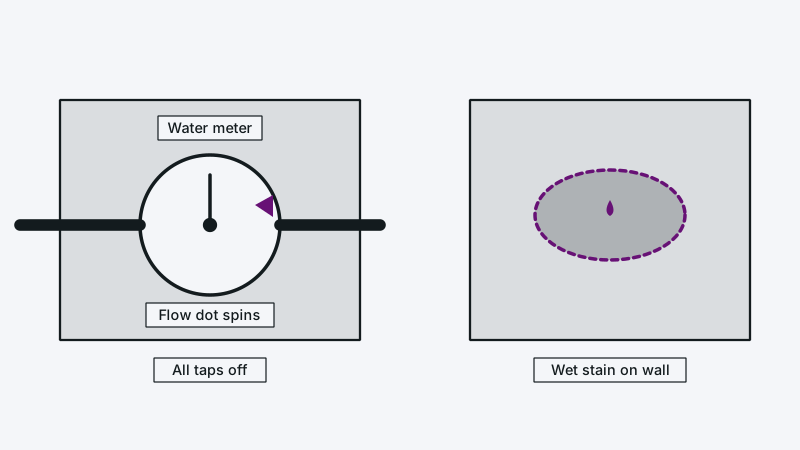
Water showing up where it has no business, a meter that creeps along with every tap shut, or pressure that suddenly sags at several fixtures all say the same thing: a pipe has split. A burst is a break, not a drip, so it tends to worsen quickly. The wider topic sits in our leaks and burst pipes guide. Below is a checklist to confirm the break and the first moves after you do.
How can you tell if a pipe has burst?
Look for stains spreading across a ceiling or wall, a floor that is damp or bulging, the noise of running water in a quiet house, and a fast drop in pressure. Spot any of these and go straight to the meter and the main shutoff. A split pipe puts out far more water than a slow leak, so it seldom stays out of sight for long.
Take the steps in this order:
- Look and listen. Switch off the TV and walk each room. A hiss, trickle or spray inside a wall points to the culprit.
- Check below bathrooms and the kitchen. Brown rings, bubbling paint and spongy drywall show that water has been moving through the structure.
- Test the pressure. Run a faucet in every area. Weak flow in some rooms and normal flow in others can narrow down the failed section.
- Read the meter. EPA WaterSense describes the method: record the number, use no water for 120 minutes, and look again. If the dial has moved, a leak is likely. A burst usually makes it spin within seconds.
- Check the water bill. EPA says the typical household wastes over 9,300 gallons a year through leaks. A single burst can waste that much in about 48 hours.
Once you find water, close the main shutoff valve. Then what to do with a burst water pipe gives the steps for cleanup and documentation.
How do you know if a pipe burst under the house or in the slab?
With a raised floor, the signs are damp soil, soggy insulation or a musty odor down in the crawl space. A slab shows itself differently: warm patches on the floor, wet carpet edges, damp cracks and running water you can hear with every fixture closed. Either way, run the meter test first, then bring in a plumber who has leak detection gear, since the break is out of view.
Many postwar Valley houses mix both styles. Raised-foundation homes carry galvanized or copper lines beneath the floor, while slab homes have pipes in or under the concrete. Suspect the slab? Our guides to slab leak detection and to repairing or repiping after a slab leak explain how the leak gets located and which options exist.
Resist the urge to cut drywall or drill the floor in search of the water. That can add damage and still miss the real source, because water travels along framing and pipe runs before it appears.
How do you know if pipes burst from freezing?
Freezing only explains a burst when temperatures actually dropped far enough. The pattern is a faucet in a cold corner giving nothing or a trickle, frost on an exposed pipe, and then water showing up as the house warms. The split usually forms where ice built up, yet the water only escapes after it melts.
Hard freezes rarely reach the Burbank valley floor, so a burst after an ordinary winter night more likely comes from pressure, age or corrosion. After an unusually cold night, inspect lines on the foothill side, in unheated garages and inside outside walls. A pipe that froze but did not split should be shut off, and you should phone a plumber before thawing it, because thawing can expose a crack. Our page on whether PEX pipe will freeze and burst addresses the material common in newer repipes, and why pipes burst goes through the causes in full.
How can you tell a burst pipe underground or outside?
Outdoors, a lawn or planter bed that stays soggy in dry weather is the giveaway. So are water welling up near the street or along the service line, a sunken patch of soil, and a meter that runs while the house is off. If pressure is low indoors and the yard is wet, suspect the service pipe that runs from the meter to your home.
The utility owns the pipe up to the meter. Beyond it, the line is generally the owner's responsibility. Burbank Water and Power lists a general line at (818) 238-3700 and an after-hours line at (818) 238-3778 if the shutoff will not turn or you cannot find it. Homes in an LA city neighborhood of the Valley get water from LADWP, so contact your own utility when the trouble is a street main. When the leak is visible and the house cannot be protected, a plumber can be arranged for urgent work, as described on our emergency plumber for a water leak page.
How do you fix a leaking pipe without replacing it?
A small leak at a joint or a pinhole can be held with a stopgap: a repair clamp, a rubber and steel sleeve, a dab of epoxy putty, or wrap-on fusing tape. They buy time, nothing more. A lasting repair removes the damaged length and puts in new pipe with parts that match the material.
Stopgaps are meant to hold the water until a plumber shows up, and they are not for a true burst. A split pipe, a gas line leak, corroded galvanized pipe or anything near electricity belongs to a professional. For the details, read about patching a leaky pipe joint without replacing it and what pipe leak sealants can and cannot do.
Published cost guides place burst pipe plumbing at roughly $500 to $2,000, and water damage restoration is billed on its own. Treat that as a guide. What counts is the figure on the written quote you receive after a visit.
What should you do right after you find a burst pipe?
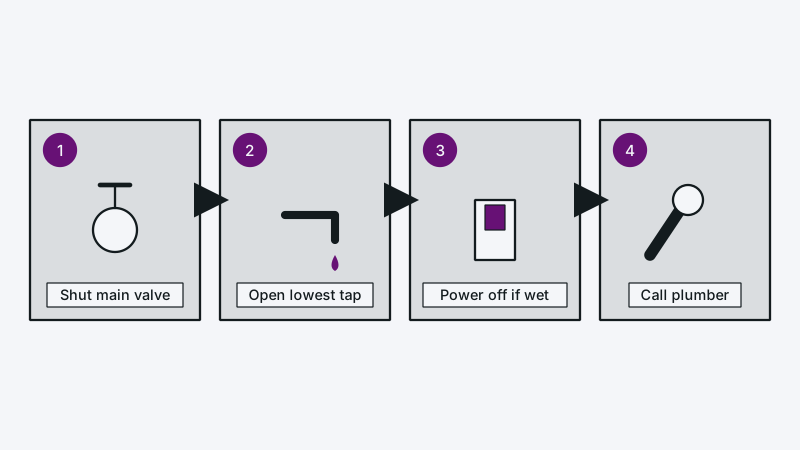
Close the main water valve, then open the lowest faucets to bleed pressure and empty the lines. If water has reached outlets, a panel or appliances, keep away and call an electrician or 911 when there is any chance of shock. Photograph everything before cleanup and phone a plumber. Waiting to see if it stops is a mistake.
A few extra points:
- Gas. At any whiff of gas, exit the house, ring SoCalGas on 1-800-427-2200 from outdoors, and use 911 for any danger to people.
- Hot water. Shut off the water heater when its tank is draining, so it will not burn out dry.
- Insurance. Read the policy and contact the insurer. Our burst pipe water damage page lists what to document.
- Sound. Banging pipes are usually water hammer rather than a burst. Wikipedia calls it a pressure surge from flow stopping abruptly, and over time it can harm pipes. The noise to worry about is a steady hiss or rush with all fixtures closed.
Questions people ask
What does a burst pipe sound like?
Expect a steady rush or hiss from a wall, ceiling or floor that continues with all fixtures shut. A drip, a gurgle from a drain or a thump as a faucet closes is something else: banging is usually water hammer, and gurgling suggests a drain. Should the sound go on after the main valve is closed, the supply line is not the source.
x
An easy-to-reach section can be swapped in a few hours. A line buried inside a wall, a ceiling or the slab takes longer, since the plumber must locate it, open the surface and make the repair. Drying out and rebuilding drywall or flooring adds days. Find out in advance how long the water stays off.
Which questions belong on my list before hiring a burst pipe repair?
Ask how the break will be located, whether the price includes cutting into walls and closing them up, whether a permit is required, and what happens when more damage turns up behind the wall. Verify the license through CSLB. Get scope and price in writing, with no big deposit up front. A phone estimate does not count as a quote.
Does someone have to be home during the visit?
Yes, at minimum when the job begins and when it ends. You point out the main shutoff, approve access to walls or floors, and inspect the result before signing off. When you cannot be present, set up access with the plumber beforehand and have a trusted adult meet them.
Can a burst pipe flood a house in a few hours?
Yes. A split in a pressurized supply line can pour out many gallons each minute, enough to soak flooring and drywall within hours. Closing the main valve is therefore the first move, and you should know where it sits before trouble starts. Find it today, tag it, and make sure everyone in the home can get to it.
Ready to book? Ask for a quote. Other problems we handle are listed on the home page.
References
Updated