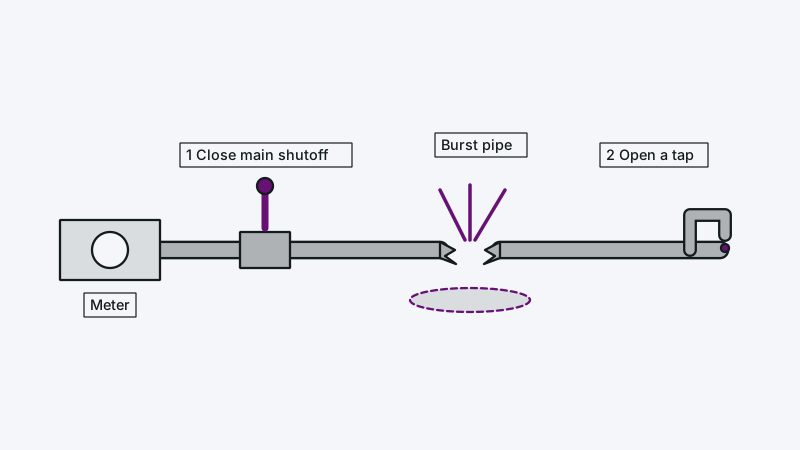
With a burst water pipe, shut the main first, then deal with electricity and the water already loose in the house. Open a low faucet to bleed the line, switch off the water heater, and take photos before you clean up. Then call a plumber. This sits within our coverage of leaks and burst pipes. Not certain it is a burst at all? telling whether a pipe has burst helps, and for a leak that cannot wait there is our page on an emergency plumber for a water leak.
What do I do in the first ten minutes?
Close the main, keep clear of electricity near the wet area, and move people and belongings away from the water. Those three steps stop the flow, cut the shock risk and save what can be saved. Everything else, including phone calls and photos, comes after the water stops, not before it.
In order:
- Find the main shutoff and close it. A round-handled gate valve closes by turning clockwise to the stop. A lever-style ball valve closes once the lever lies across the pipe. When it resists, skip the tool that could snap the stem. Try the meter shutoff instead and call for help.
- Open a tap on the lowest floor, and a high one, to let the pipes drain and take pressure off the break.
- Stay out of standing water around outlets, appliances and the panel. If water is reaching anything electrical, touch nothing. Cut power at the breaker only when you can get to it with dry feet, and otherwise phone 911 or the utility.
- Turn off the water heater. For an electric heater, flip its breaker; for a gas heater, turn the control to off or pilot. A heater that keeps firing while the house is drained can be damaged.
- Move valuables up, lift rugs, and put buckets under any ceiling drip.
- Do not stand under a bulging ceiling. Water can hold in the drywall and drop at once. A small hole poked at the lowest point, from the side, drains it into a bucket, provided you can reach it from a safe position.
EPA WaterSense notes that household leaks waste nearly 1 trillion gallons of water a year across the country. A burst is a leak at full speed, so the main shutoff is the single most useful thing to know in your house.
Where is my main water shutoff in a Burbank or Valley home?
Look where the supply line comes into the house on the street side: a valve on the front wall by an outdoor spigot, in the garage, inside a closet or at a crawlspace vent. Many Valley ranch homes have one near the water heater. A second shutoff, the meter valve, sits in a box in the front yard near the sidewalk.
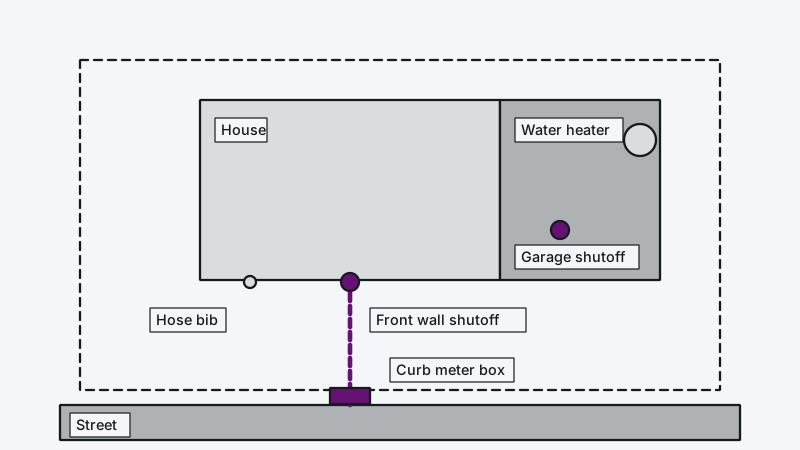
Find it today, not during the emergency. Look for:
- The pipe that goes into the wall nearest the street. Follow it back to a valve.
- A meter box lid in the parking strip or lawn. The utility-owned valve inside belongs to your water provider. Burbank Water and Power serves Burbank and Glendale Water and Power serves Glendale. LADWP serves the Los Angeles neighborhoods of the Valley. Ask yours what you may and may not turn.
- A yellow or red tag that someone left on an old gate valve. Tag it yourself now.
Exercise it yearly by closing and reopening it. Old gate valves seize, and one untouched for twenty years may refuse to budge on the day it counts. If yours is stuck, a plumber can replace it with a ball valve, and that is a small job worth doing before a burst.
What should I photograph and write down?
Take photos and short video of the water, the pipe, the damage and the room before you clean up, and keep notes on the time you found it and every step you took. Your insurer will want this, and it also protects you if a dispute comes up later. Keep damaged items until the insurer says you can throw them away.
A useful record includes:
- Wide shots of each affected room, then close ups of wet walls, ceilings, floors and furniture.
- The burst itself, before the plumber touches it, if you can see it safely.
- The water meter and main valve, with the time.
- Receipts for anything you buy to limit the damage, such as fans, tarps or a water extraction service.
- The plumber's invoice and notes, which should say what failed and why.
For drying, mold and cleanup, see water damage after a pipe bursts. On coverage, check whether a burst pipe is covered by insurance, and call your insurer promptly, since most policies ask you to act fast and protect the property from more damage.
When should I call a plumber, and what will they do?
Phone once the water is off, since the pipe must be repaired before the supply returns. A local plumber visits, locates the break, cuts out the damaged stretch, fits new pipe and pressure tests the line. On the same visit, they should look for why it failed, so it does not happen again.
Expect these steps:
- Find the break, sometimes behind a wall or above a ceiling. A moisture meter or a camera can help, and in tougher cases the plumber uses sound or thermal tools. See our guide to acoustic leak detection for one of those.
- Repair or replace the section. A short patch is enough while everything else on the line is healthy. If the pipe is old, thin or pitted all over, a larger replacement may make more sense.
- Check the pressure. Very high pressure at the house puts stress on every fitting. A plumber can test it, and fit or adjust a regulator if needed.
- Restore the water slowly, checking each joint and each fixture.
For the causes, read why pipes burst. To lower the odds of a repeat, see burst pipe prevention. Ready to book? Fill in the quote page and a visit with a written quote gets set up.
Can I fix a burst pipe myself?
For a temporary stop on an accessible pipe, a repair clamp or push fit coupling can hold things until help arrives, but plan on a proper repair. Anything inside a wall, under a slab, tied to the gas line or on the water heater needs a plumber. A permit can apply to larger repairs and repiping, so ask first.
Temporary measures that are reasonable:
- A rubber and clamp patch on a minor split along a straight run of exposed pipe.
- A push fit repair coupling for a short break on copper, PEX or CPVC if you know the pipe size. The pipe must be clean and cut square.
- A shutoff at the fixture if the burst is a supply line beneath a basin or behind a toilet. Those small valves are the first thing to try.
Things to leave alone:
- Any gas line, which belongs to a contractor holding the proper license, and a permit.
- Water heater plumbing, where heat and pressure make mistakes costly.
- Lead or old galvanized pipe if you are unsure. Treat suspect pipe with care and ask a plumber.
- Anything near electrical equipment.
The CSLB, the state contractor board, has a license check on its site, and it is worth a minute before you hire.
Plumbing service in Burbank begins at the home page.
Questions people ask
How long will fixing a burst pipe take?
Once a plumber arrives, an easy-to-reach break can often be mended within hours, whereas one hidden in a wall, beneath a slab or along extended old pipe takes longer, and drying the building takes days. The plumber should tell you after looking. Water stays off until the repair and pressure test are done.
Do I switch the water heater off after a burst?
Usually yes. With the main closed and the house draining, an electric element can burn out dry and a gas unit can overheat. For electric, flip the breaker; for gas, turn the unit to off or pilot. Read the label, and ring a plumber if unsure.
Is a burst pipe an emergency?
Yes, because water does damage quickly to drywall, floors and wiring. Shut off the main, call a plumber and, if electricity is involved or water is coming through a light fixture, call 911 or the utility. Water still running means you should not hold out for office hours.
Do I call my insurance company first?
Water off first, phone call second. Most homeowner policies expect you to take reasonable steps to prevent more damage, and they want photos and a plumber's report. Whether the loss is covered depends on your policy and the cause, so read it, and ask the insurer for a claim number before you pay for large work.
What if the pipe burst while I was away?
Shut off the main when you arrive, and stay out of the house if water is near the panel or the ceilings look swollen. Photograph everything and call a plumber and your insurer. If you travel often, a smart shutoff or a leak sensor can limit the damage. See our page on smart water leak detection.
References
Updated