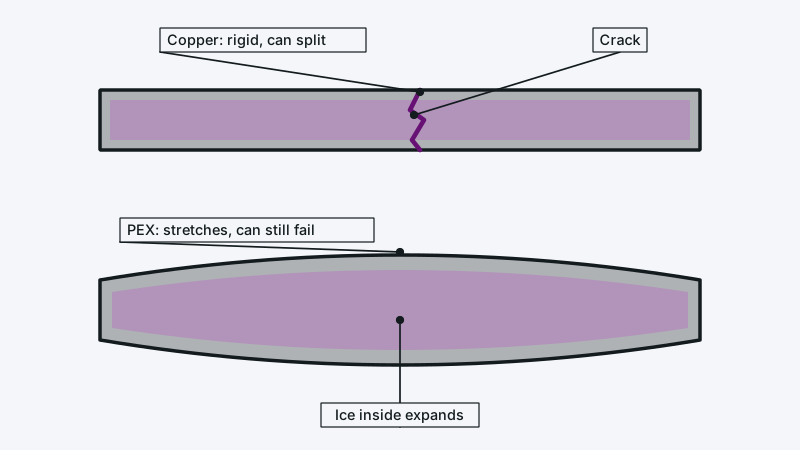
PEX pipe can freeze, and it can burst, but it is more forgiving than copper or PVC. Its flexibility lets it swell when ice forms, so a single freeze often passes without a split. Repeated freezes, a hard freeze or a rigid brass fitting can still fail. If you live in the Valley, the risk is low but not zero. Our guide to leaks and burst pipes covers the rest of this topic.
Can PEX pipe freeze and burst?
Yes. Water expands when it turns to ice, and the pressure can split any pipe at the frozen spot. PEX is generally understood to be more burst resistant than copper or PVC because it is flexible, but it can still freeze, and a hard or repeated freeze can split it. The fittings are the usual weak point.
Wikipedia's article on cross-linked polyethylene sums up the common understanding. Frozen water-filled PEX pipe tends to swell and tear, where copper rips and PVC shatters. It also reports a 2007 home expert claim that PEX could take five or six freeze and thaw cycles without splitting, and it warns that those freezing claims come mostly from news and advice sources of the 2006 to 2009 period, not from controlled testing. So treat "PEX never bursts" as a myth and "PEX handles a freeze better" as a fair rule of thumb.
What decides whether a frozen PEX line fails:
- Fittings. Brass and plastic fittings do not flex like the tubing, so they split first.
- Whether it is trapped. A closed section with a valve at each end has nowhere for the expansion to go. A line with an open tap downstream can relieve pressure.
- How cold, how long. A brief frost may make slush. A long hard freeze makes solid ice.
- How many times. Each freeze fatigues the pipe and fittings.
Does a frozen pipe always burst?
No. A frozen pipe often does not burst when it freezes. The ice plug blocks the flow, and the splitting usually comes as the ice melts, or where the ice builds pressure between the plug and a closed tap. A pipe that froze may be damaged and only show it later, when it thaws and the water runs.
That is why a frozen pipe needs a careful thaw:
- Open the tap nearest the frozen section, so melting water and steam have an exit.
- Warm the pipe gently, starting at the end nearest the tap. A hair dryer or warm towels work. Do not use a torch or any open flame, which can start a fire and damage the pipe.
- Watch for leaks as the water flows again. Keep the main valve location in mind, as described in what to do with a burst water pipe.
- Do not leave the house until the water is flowing and all joints are dry.
If you see frost on a pipe, no water at the tap, or a pipe that has bowed or bulged, treat it as frozen. A pipe buried in a wall or an unreachable crawlspace is a thaw for a plumber.
Should I worry about frozen pipes in Burbank and the San Fernando Valley?
It is a small risk, not a big one, and mostly a worry for pipes that are exposed. Valley floor nights rarely stay below freezing for long, but cold clear nights do occur, and homes on the foothill edges and in higher parts of the Santa Monica Mountains and Verdugo foothills can see colder air. We have no official figure for Burbank freeze days, so check the National Weather Service forecast.
Where the risk shows up in a local home:
- Hose bibs and exposed lines on a north wall. The classic frozen spot.
- Pipes in unheated garages, attic runs and crawlspaces that were laid out for a mild climate and have no insulation.
- Outdoor irrigation lines and backflow assemblies above ground. See our page on sprinkler system leak detection.
- Vacant or second homes where nobody notices a problem.
Many 1940s to 1960s Valley homes were built with the pipe in places that do not matter in a mild climate, such as outside walls and garage ceilings. That is an extra reason to insulate exposed sections before a cold snap, and to read about burst pipe prevention.
How can I protect PEX pipes from a freeze?
Insulate exposed runs, cover hose bibs, keep a little heat where pipes run, and let a tap drip on the coldest nights. These steps cost little and protect all pipe types. For a vacant house, shutting off the main and draining the lines is safer than hoping the weather stays mild.
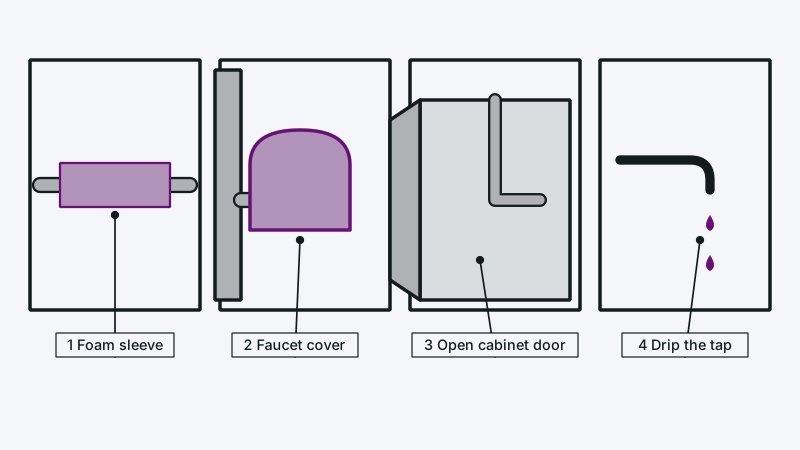
Practical steps:
- Insulate exposed pipe in garages, crawlspaces and attics with foam sleeves. Include the section next to the wall.
- Cover outdoor faucets and disconnect hoses before a cold night.
- Leave cabinet doors open beneath sinks on exterior walls.
- Let a tap drip on the coldest nights. Moving water is harder to freeze, and a tap relieves pressure.
- Learn the main shutoff location, and keep the valve working.
- Consider a smart shutoff or leak sensor if you travel. See smart water leak detection.
If your home has PEX in an unheated space and you want it checked, send a request on our quote page and a local plumber can come out to look.
Other plumbing questions are answered across our Burbank plumbing site.
Questions people ask
What temperature will PEX pipe freeze at?
PEX freezes when the water in it does, at 32 degrees Fahrenheit, though a pipe usually needs sustained cold to freeze solid. Wind, an uninsulated run and exposure to open air speed it up. A moving line, or one in a heated space, is much slower. A cold night in the Valley seldom does it.
Can PEX pipe burst from freezing more than once?
It can fatigue. PEX is described as tolerating several freeze and thaw cycles, but the source of that claim is anecdotal, and each freeze stresses the pipe and fittings. A pipe that froze should be inspected for swelling, kinks and weeping fittings. Replace damaged sections rather than waiting to see.
Which pipe is worse in a freeze, PEX, copper or CPVC?
Copper and rigid plastic tend to split in a hard freeze, while PEX more often swells. None is freeze proof. Fittings fail first on every pipe type. The best protection is keeping pipe from freezing, with insulation, heat and a drip, not picking a material and hoping.
How do I know if PEX froze and split?
Signs include no water at a tap in cold weather, a bulge or a swollen section of pipe, a fitting that weeps when thawed, a damp spot in a wall or ceiling, and a meter that keeps turning with everything off. More detail in telling whether a pipe burst.
Is a frozen pipe covered by insurance?
Often a sudden burst is covered, while a leak that comes from lack of upkeep may not be. It depends on your policy and its wording, including any rule about keeping the home heated. Read it and ask your insurer. The common rules are explained in burst pipe insurance coverage.
References
Updated