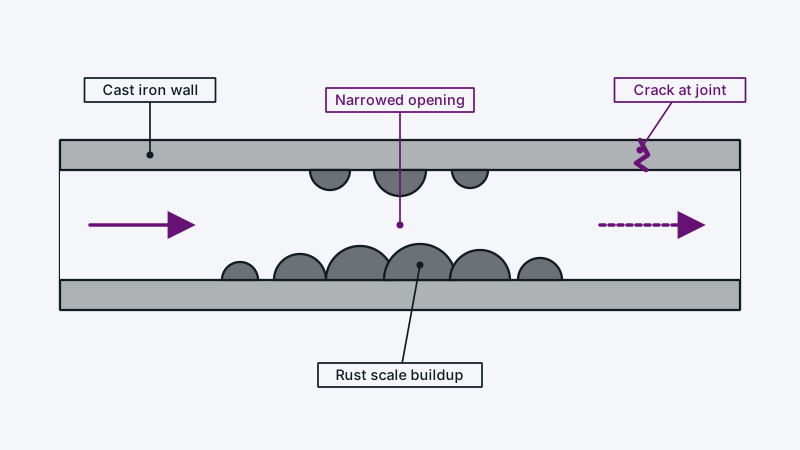
Cast iron pipe carries waste out of the house. It is the drain side, not the water you drink, which makes it different from the supply lines covered in repiping and pipe replacement. In older Burbank and Valley homes it often runs under the floor and out to the sewer connection. Replacement means swapping cracked or scaled sections for plastic, or lining the old pipe. We'll arrange a plumber to scope it. Start on the quote page.
How do you know cast iron drain pipe needs replacing?
Warning signs include sluggish drains across several fixtures together, gurgling, sewage smells, wet spots in the yard or under the slab, and repeated clogs that return after cleaning. Cast iron rusts and scales inside, narrowing the pipe until it catches paper and grease. A camera inspection through a cleanout shows the pipe wall, cracks and root intrusion without cutting anything open.
Plumbing references list cast iron among the materials used for drain and vent lines, alongside plastic, steel and lead. Builders reached for it routinely in houses put up before plastic took over. Burbank has older housing, with more than 62 percent of homes built before 1970, so cast iron is a likely suspect in the 1940s and 1950s tracts of Magnolia Park and the surrounding Valley.
What does cast iron pipe replacement involve?
The plumber confirms the problem with a camera, plans the route, and replaces the bad sections with new pipe, usually plastic, tied into what remains with the right couplings. Inside a house that can mean cutting into walls or breaking the slab to reach the line. Outside, it can mean digging a trench. Replacement is permitted work with an inspection before anything is buried or covered.
Where cast iron meets another metal, plumbing references note that special non-conductive fittings are needed to prevent galvanic corrosion. That detail is the kind of thing to ask about in the quote. Have the plumber play back the camera footage and mark the damaged stretches, so you learn whether the whole line or only part is being replaced.
Can cast iron pipe be lined or burst instead of dug up?
Sometimes. With cured-in-place lining, a resin-soaked sleeve is drawn through the existing line and hardened there, forming a fresh pipe within the old, typically with little or no digging. Pipe bursting drags replacement pipe along the old route while fracturing the original. Both are trenchless, and both depend on the pipe's condition, size, bends and the access points available.
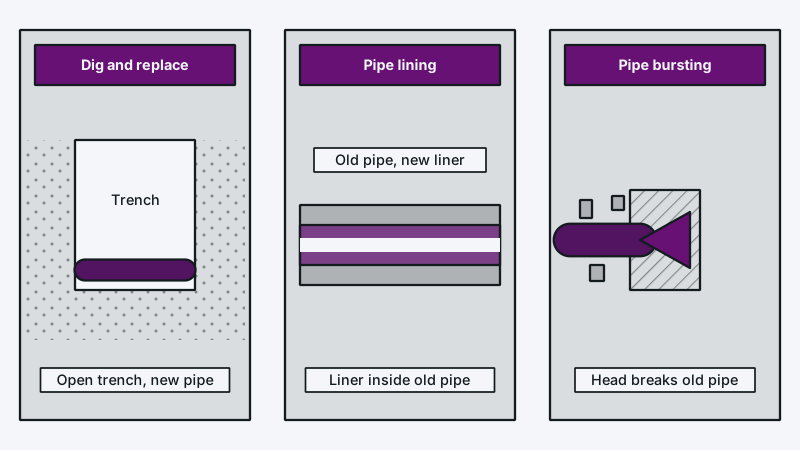
These methods have limits. Lining needs the line cleaned and obstructions removed first, afterward the lined pipe gets cleaned with water jets rather than cables, and curing takes time. Pipe bursting needs pits at each end. Only after reviewing the camera footage can a plumber say which one fits. Neither method is automatically cheaper, so ask for each in writing.
Do I need a permit for cast iron pipe replacement?
A permit is likely. CSLB says the California Building Standards Code requires a permit for work that alters or repairs a structure, and local building departments enforce it. Burbank uses its Building Division, Glendale uses Building and Safety, and LA city neighborhoods go through LADBS. Any work requiring a permit also calls for a contractor license.
The plumber usually takes out the permit and books the inspection. Drain work is inspected before it is covered, with a test of the new piping. If the line goes under a street or sidewalk, a separate public-right-of-way permit may apply, so ask the city. Never accept an offer to skip the permit, because an unpermitted job can complicate a sale or an insurance claim.
How much does cast iron pipe replacement cost?
No cast iron replacement price source met our standard, so no number appears here. What sets the cost is the length of pipe, the depth, whether it is under a slab, driveway or landscaping, the access, the method, and the permit and inspection. Short, accessible repairs cost far less than a full run under a house.
Replacing a section inside a wall is a very different job from replacing the line under a slab. Quotes should name the method, the pipe material, the footage, the repair of floors, concrete or landscaping, and the permit. Because digging and restoration can outweigh the pipe itself, trenchless options are worth pricing. Our repipe cost page covers the supply side for comparison.
What happens if you wait?
A cracked cast iron drain leaks sewage into soil or under the house, and roots can grow in through the cracks. Waste can back up into tubs and floor drains. It can also let sewer gas into the home. Waiting rarely saves money, because a small repair done early is usually cheaper than a collapsed line later.
Sewer gas can contain hydrogen sulfide, which smells like rotten eggs, and it can be flammable. In most homes it is a nuisance, but a strong smell indoors deserves attention. Should the smell be overpowering or leave you dizzy, get out of the house and dial 911. Common causes are listed in our guide to getting rid of sewer smell.
Should you repipe the supply lines at the same time?
Sometimes, if both systems are old and walls are open anyway. A 1950s house may have galvanized steel supply pipes and cast iron drains, and doing both once can save on access and patching. If only one system is failing, there is no reason to touch the other. Get the camera look and a pressure test before deciding.
Read about galvanized pipe replacement to see how the supply side behaves. Some owners also compare pipe materials, which our PEX versus copper page covers. Back on the Lankershim Plumbing home page you can find other plumbing guides for Burbank homes.
Questions people ask
What is the timeline for replacing cast iron pipe?
It depends on length and access. A short section in an open crawl space can be a day. A run under a slab or through a yard can take several days once digging, plumbing, inspection and restoration are counted. Lining can be quicker than digging but needs prep and curing time. The written quote should give a schedule, including the hours of water shutoff.
How do I know the plumber's camera findings are real?
Ask to watch the footage with the plumber instead of hearing a summary. It should show the cleanout, the cracks or scale and the distance along the line, and you should be able to keep a copy. If a quote calls for replacing the whole line, ask which sections are failing and which are sound.
Can I use my toilets and sinks while the work is going on?
Usually not while the line is open. Drains upstream of the work can't carry waste away, so avoid flushing and running water during work hours and ask when service returns. Some jobs restore use each evening and some don't. Ask whether you will need a temporary arrangement for toilets.
Can cast iron pipe be repaired without replacing all of it?
Often, yes. If the camera shows only one failed section, the plumber can cut that out and join in new pipe, or use a spot liner. If the pipe is scaled throughout, a partial fix may leave other weak spots. Ask what the camera shows for the rest of the line, and whether a full run lined or replaced is the better value.
References
- Plumbing, drain and vent materials (Wikipedia)
- Cured-in-place pipe lining (Wikipedia)
- Pipe bursting (Wikipedia)
- California Contractors State License Board, what kind of contractor do I need
- California Contractors State License Board, building permit requirements
- Burbank, California housing (Wikipedia)
- City of Los Angeles Department of Building and Safety
Updated