
A water pipe leak sealant buys time on a small leak in a dry, sound pipe. Epoxy putty and repair clamps last longest, self-fusing tape lasts a short while, and liquid stop-leak products perform worst on pressurized house lines. No sealant mends a corroded or cracked pipe. This page belongs with our help on leaks and burst pipes.
Does a pipe leak sealant actually work?
On a small leak in sound pipe, yes, for a while. It gives out on wet or corroded pipe, under high pressure, or at a joint that moves. A sealant only slows the water until the section is cut out and replaced. It cures nothing. The pipe around the leak is the real issue.
Three things decide the result: a clean, dry surface, a product rated for water and for your pipe material, and a small leak. A pinhole in copper or a weeping thread makes the best candidate. A split, a joint that moves, or a pipe flaking inside makes the worst.
Most patches fail in the same way. They hold for hours or days, the pipe keeps corroding beneath, and the leak reappears beside the patch, often inside a wall. For that reason every product here is a bridge to a repair, nothing more. For permanent copper options, see leaking copper water pipe repair.
Which type of sealant works for which leak?
Use repair clamps on pinholes and small splits in sound pipe. Use epoxy putty on a dry pinhole or a weeping fitting. Use self-fusing silicone tape on a sweating joint or a minor drip. Thread sealants go on threaded fittings as they are assembled. Liquid stop-leak additives are made for closed heating loops, never for drinking water pipes.
| Product | Best for | Weak at |
|---|---|---|
| Rubber-lined repair clamp | Pinholes, short splits on round pipe | Joints, crushed or corroded pipe |
| Two-part epoxy putty | Dry pinholes, small cracks, fitting seams | Wet pipe, moving joints, high pressure |
| Self-fusing silicone tape | Small drips, sweating, short-term wraps | Anything under real pressure, such as a split |
| Thread seal tape or paste | Threaded fittings, during assembly | Fixing a leak after the fact |
| Push-on repair coupling | Cut and replace a damaged section | Not a sealant, but the real fix |
| Liquid stop-leak | Closed hydronic or heating loops | Domestic water lines |
Duct tape, packing tape and gorilla tape are missing here deliberately. A pressurized water line will not stay sealed with them.
On drinking water pipe, read the label first. It should say the product suits potable water, for example with an NSF/ANSI 61 marking. A label that is silent on this rules the product out for a line you drink from.
How do you apply a sealant so it holds?
Close the water supply, empty the line, and get the pipe dry. On metal pipe, scrub with a wire brush or sandpaper until bare, shiny metal shows. Follow the package directions to the letter, give it the full cure time, and reopen the water slowly. Look again an hour later, and again the next day.
The order that gives a repair its best chance:
- Shut off and drain. Putty will not stick to wet pipe.
- Dry it thoroughly with a rag, then a hair dryer on low if needed. Keep flames well away from anything flammable.
- Roughen the surface. Rust, scale and old paint block adhesion.
- Knead and press on the putty, or wind the tape under tension so each turn overlaps the last.
- For a stronger patch, add a clamp over the putty.
- Respect the cure time printed on the package before pressure returns.
- Bring pressure back slowly while you watch.
Some joints respond to a fix at the joint itself, and our guide on fixing a leaking pipe joint without replacing it shows which.
If the leak hides in a wall or beneath a floor, do not seal it and close things up. A patch you cannot see is one you cannot check.
Why do sealants fail on Burbank houses?
Usually the pipe is to blame, not the product. Many Valley houses built in the 1940s through the 1960s still carry aged galvanized steel or worn copper. A patch on thin metal can fail right next to itself. Street pressure, hot water cycles and water hammer all strain a repair with no mechanical backing.
Pressure counts for a lot. House lines are never at rest, and a patch that holds at the kitchen sink on a calm afternoon may give way when a dishwasher valve snaps shut. Hot lines also swell and shrink with each heat cycle, which wears at adhesives and tapes.
Pinholes that come back in several places are a sign of a pipe problem, not a patch problem. Wikipedia's copper tubing article describes how stray current can cause pitting, and corrosion from water chemistry can do something similar. Whatever the cause, patches do not cure it. Two leaks in one year is the point to have a plumber price a full replacement of the run. See copper versus PEX plumbing and whole house repipe to compare options.
When should you not use a sealant at all?
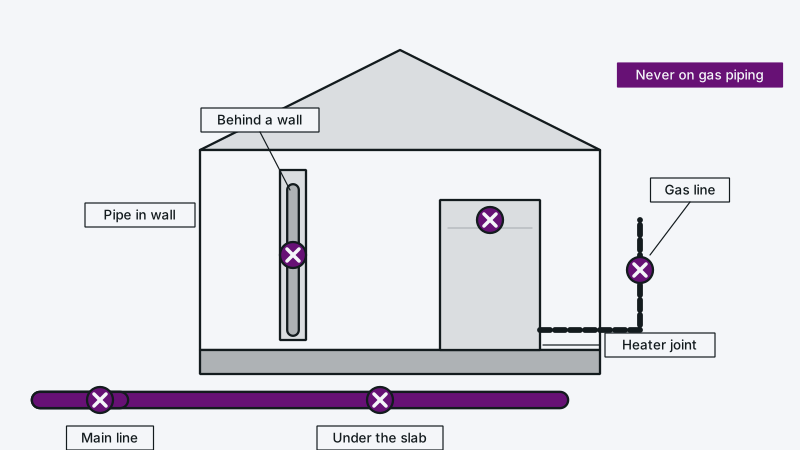
Leave it alone when the pipe runs behind a wall, under a slab, as the main line, near gas, at a water heater connection, or is spraying. Leave it alone too when the pipe is brittle, bulging or flaking. A sealant that fails in those places hides the trouble and invites water damage that costs far more than a proper repair.
To head off mold, the EPA advises drying water-damaged areas inside two days at most (24 to 48 hours). A patch weeping quietly inside a wall for a week is just what that guidance is meant to prevent. Inspect the patch and the wall often, and replace the pipe soon.
Also stop in any of these cases:
- The leak is close to electrical equipment.
- You smell gas. Walk out, and from outside ring SoCalGas at 1-800-427-2200, or dial 911 if anyone is threatened. Never try a sealant on gas piping.
- The pipe could be lead, or part of an old system you cannot identify.
- The home is a rental, so the landlord needs to know.
How much does it cost to skip the sealant and fix it properly?
A proper fix on a pipe you can get to commonly costs a few hundred dollars. Fixr's published guide puts typical burst pipe repair at $200 to $1,000, with an average near $500, and adds that pipes behind walls cost more to reach. A sealant costs a few dollars. The difference pays for a repair that lasts.
Be honest about the trade. A sealant that carries you through a weekend until a plumber arrives is good value. One you lean on for months is not, because a hidden leak can inflate your bill and harm the structure. The EPA's Fix a Leak Week guidance notes how much water ordinary leaks waste: an average family wastes about 9,400 gallons a year.
To see how a repair quote is put together, read plumber leak repair cost.
Through the quote form, describe the pipe, the leak and whatever you applied. We line up a local plumber who visits you, and a quote in writing reaches you ahead of the work.
Questions people ask
How long does water pipe leak sealant last?
Anywhere from hours to a few weeks, depending on the product, the pressure, the pipe and how carefully you prepped the surface. Consider whatever you apply to be temporary. A clamp or epoxy on sound, dry pipe may outlast tape, but none stands in for a repair, so inspect it daily.
What do I ask a plumber about a pipe I already sealed?
Say precisely what you applied and when. Ask if the quote covers inspecting the pipe around the patch, which repair method is planned, and whether the price includes patching any wall or floor. Request the contractor license number and confirm it with the state.
Must I be home when the plumber replaces a temporary seal?
Yes. Someone has to point out the leak and the shutoff and approve any change. The plumber will take off your patch, and what lies under it may alter the plan. Leave the patch on so the failure can be seen.
Is leak sealant safe for drinking water?
Only when the label says it is. Check for a potable-water rating like NSF/ANSI 61. Plenty of sealants are made for heating loops, roofing or general repair and were never meant to touch drinking water. If the package is silent, keep it off supply lines.
The rest of our guides start from plumber burbank.
References
Updated