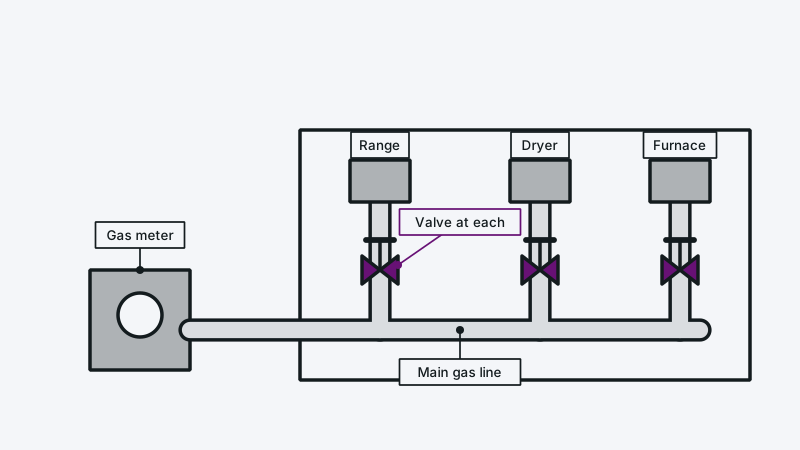
Expect a gas line job to cost $120 to $1,350, with an average near $558 in one guide and $268 to $841 in another. That same guide puts the California average near $956. Replacing the gas line through a whole house costs $3,000 to $7,000. Treat these published national and state figures as a guide, since the real price comes in a quote after a visit. Gas work in Burbank also needs a permit and inspection. Our gas line plumber page shows how the work runs.
How much does a plumber charge to install a gas line?
Pricing lands near $15 to $25 for each linear foot of gas line to a fireplace, furnace, grill, stove, dryer or water heater, with pipe and labor both counted. Simple appliance hookups often total $243 to $823, and a fresh run to an appliance can reach $1,600. A whole-house replacement is $3,000 to $7,000.
By room, the per-foot figures differ: about $10 to $15 in a kitchen, $10 to $20 in a bathroom or bedroom and $10 to $25 in a garage. Trenching an outdoor line adds $4 to $12 per foot, depending on depth. For a new gas stove, a typical 30-foot run can total near $600 in one guide. Have the footage written into the quote so you can check the math.
What does a typical gas line price look like in Burbank?
The best guide for Burbank is the California average of about $956 from one published source, set beside the national range of $120 to $1,350. City labor rates run higher, and that guide adds $100 to $300 for permits and around $50 to $75 for inspections. Burbank sets its own permit fees, so ask the Building Division.
| Job | Published range |
|---|---|
| Typical gas line job, national | $120 to $1,350 |
| Gas line job, California average | about $956 |
| Hook up a new appliance to an existing line | $243 to $823 |
| New gas line to an appliance | $431 to $1,609 |
| New line from street to the house | $382 to $1,298 |
| Whole-house gas line replacement | $3,000 to $7,000 |
| Plumber hourly rate | $45 to $200 |
| Permit | $100 to $300 |
Use the table to frame your questions, and let the written quote settle the price.
What pushes the gas line price up or down?
Length of pipe, number of bends, access through walls and slabs, trenching, appliance count and permit and inspection fees all move the price. A run along an open crawl space is inexpensive. One that crosses a slab or needs a trench through rock or clay is not. Swapping out old pipe to meet current code costs more than new work.
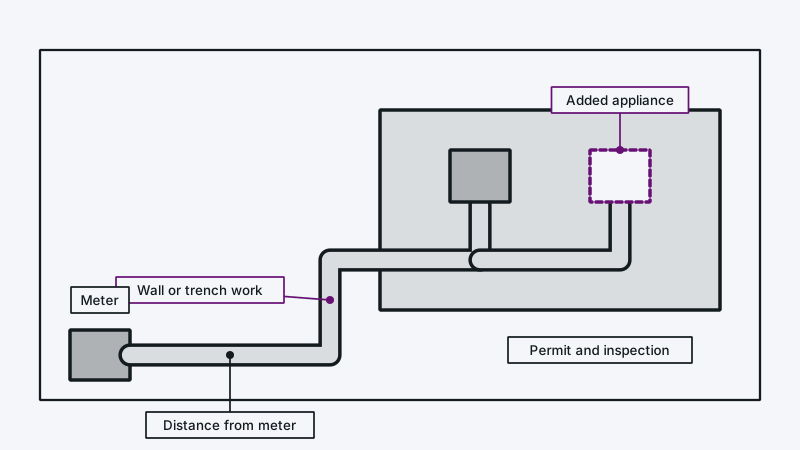
In earthquake country like the San Fernando Valley, bracing and flexible connections add cost to some jobs. Restoring finished surfaces adds more: drywall repair runs $270 to $760, flooring $2 to $30 per square foot, and re-landscaping after a yard trench can run $300 to $10,000. Ask if the quote covers closing up whatever gets opened.
For leak repair, published figures are $120 to $250 behind a stove, $270 to $760 inside a wall or crawl space, and $1,500 to $5,000 once the line is buried. Smell gas? Exit the building, phone 1-800-427-2200 for SoCalGas once outdoors, and ring 911 if there is danger. Skip the quote hunt.
How much does gas pipe itself cost?
Pipe is the smallest slice of the bill. Published materials-only figures per foot are about $4.90 for black iron, $2 to $4 for corrugated stainless steel tubing (CSST) and $2 to $5 for stainless steel. Labor, fittings, valves, testing and the permit make up most of the total, so picking a cheaper pipe saves little.
The plumber and local code decide which pipe goes in. Black iron is rigid, durable and common indoors. CSST bends, routes easily through tight spaces and sometimes installs faster. Your city's rules govern what is allowed and how it must be bonded or protected, so ask which they plan to use and the reason. Our residential gas piping codes guide explains the rules.
How much does an earthquake gas shutoff valve cost to install?
One published guide lists about $100 to $300 for the valve and $150 to $200 for labor, so $300 to $500 installed. A general shutoff valve and an automatic seismic valve do different jobs, and prices vary by model. Ask which type is going in.
Many Valley owners ask about these valves because of the 1994 Northridge earthquake. Whether a given job needs one is set by your city, so ask the local building department: Burbank's Building Division, Glendale Building and Safety, or Los Angeles Building and Safety. Use and resetting are covered on our pages about earthquake gas shutoff valves and resetting one.
How much does a plumber cost to fix a pipe, and what about gas plumber hourly rates?
Plumbers bill $45 to $200 an hour, apprentice to master level, and one guide lists service call fees of $100 to $350. Gas work can land in the upper half, because it calls for a plumber holding the proper license class and a permit. The UK has the "Gas Safe" register, while in California you check the state license.
A different guide puts an ordinary leaking water pipe at about $228 to $752, but gas lines include leak testing and a permit, so they run higher. For hourly rates in general, read the guide to plumber hourly rates.
What is a gas pipe connector and what does it cost?
A gas pipe connector is the short flexible line joining the rigid gas pipe to an appliance, for example a dryer, stove or water heater. The labor to swap one is usually quick and cheap, though you still pay for the visit. Corroded or kinked connectors should be replaced whenever an appliance is moved.
Do not pair a used connector with a new appliance, and do not make the joint with hardware-store tape and a wrench unless you are sure the work is lawful for you. A gas connection must be leak tested afterward, which a plumber does. A water heater swap includes the gas connection, and its price is on our page about gas water heater replacement cost.
Questions people ask
How long will a gas line job run?
Hooking an appliance to an existing line often takes a few hours. A new run through a house eats most of a day. A whole-house replacement takes several days, with inspection in between. Permit and inspection scheduling often drive the timeline more than the work itself, so raise them when you book.
What do I ask a gas line contractor first?
Get the contractor's California license number and verify it using the state's License Check page. Learn who pulls the permit, whether the quote covers the pressure test and inspection, which pipe goes in, and what wall or floor repairs are covered. Have every answer in writing before work begins.
Must I be present during gas line work?
Yes. Have an adult on site at the beginning to point out the appliance and meter locations, and at the end for the walkthrough. Gas will be off at points during the work, so expect no cooking or hot water for some hours. The inspector may need access too.
Is a gas line price per foot or per job?
Both. Plumbers often give a per-foot number, around $15 to $25 for common appliance lines, and then add permit, valve and repair items. A fixed price for the entire job is common as well. Request the footage and line items so two quotes can be compared on equal terms.
Does the gas company pay for a new gas line in my house?
Not usually. The gas utility generally owns and maintains pipe up to the meter, and piping from the meter into your home is yours. One guide lists meter installation fees of $300 to $600, though utilities often absorb them. Ask SoCalGas what applies at your address before setting a budget.
For what the work involves beyond the price, see Burbank plumber.
References
- Bob Vila, gas line installation cost (ranges, per-foot figures, California average, valve and permit costs)
- Thumbtack, gas line installation cost guide
- Bob Vila, how much a plumber costs (hourly rates, service call fees)
- Los Angeles Department of Building and Safety (permits and plan review information)
- California Contractors State License Board, License Check
Updated