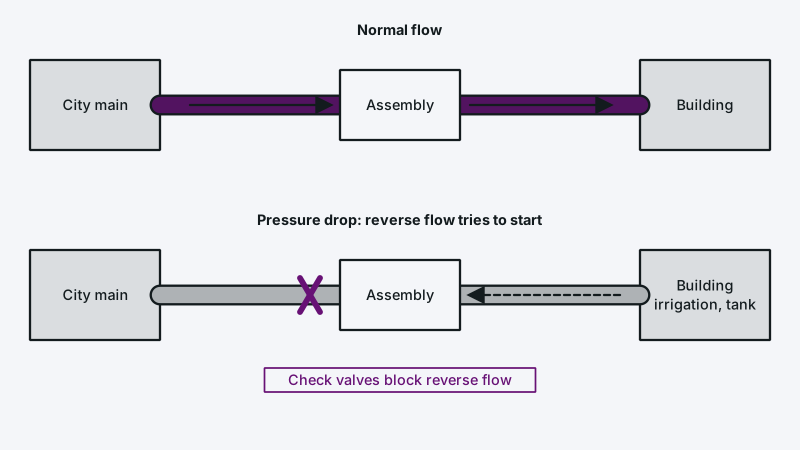
Backflow prevention testing is a short yearly check in which a qualified tester confirms that the valves on your backflow assembly close tightly and the relief valve opens when it should. The goal is simple: dirty water must never flow backward into the drinking supply. It is one of several jobs in our permits, codes and inspections section, and this page explains how the test runs.
What does a backflow prevention assembly actually do?
It lets water flow one way, toward your taps or sprinklers, and shuts the path if water tries to go the other way. Wikipedia describes the device as a barrier that keeps contaminated liquids from flowing back into the drinking water supply, often when pressure drops or back pressure builds, so a failed one can put irrigation or pool water into the main.
Three assembly types come up in Burbank:
- Reduced pressure principle assembly (RP, also called RPZ). Two check valves with a relief valve between them. It is used where the hazard is higher.
- Double check valve assembly (DC). Two check valves in series, for lower hazards.
- Pressure vacuum breaker (PVB). Common on lawn irrigation, it vents to the air when pressure falls.
Wikipedia adds that an air gap is the simplest and most reliable protection, but it is not always practical. The kind of assembly on your property was set by the hazard, so a tester reads the tag rather than guessing.
Who needs backflow prevention testing in Burbank?
Only properties with an assembly. According to Los Angeles County Public Works, not every home or business needs one, and the higher-risk sites usually include irrigation systems, pools, fire sprinklers, medical facilities, restaurants and businesses that use chemicals. If Burbank Water and Power finds a hazard, it requires an approved device and sends you a yearly notice.
BWP's page says it mails a notice and a test form about one month before the compliance month, with the due date on the form. If you got one, you have an assembly and a test due. If you did not and you are unsure, call BWP at (818) 238-3700. Commercial sites follow the same cycle, covered on commercial backflow testing.
What happens during a backflow test?
The tester shuts off the water to the assembly, attaches a calibrated gauge kit to the test cocks and checks that each check valve holds pressure and the relief valve opens at the right point. A simple test takes well under an hour. The tester records the readings on the form, restores water and tells you whether the assembly passed.
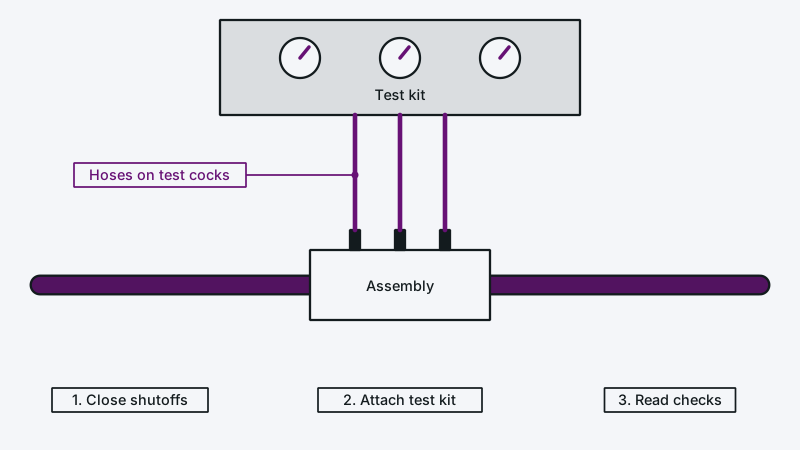
Steps in order:
- The tester confirms the assembly type and location against your notice.
- Water is turned off briefly. Tell the household before a tester arrives.
- Gauges go on and each valve is tested in sequence.
- A pass is recorded. A fail means the tester can repair it or tell you what part is needed.
- The tester submits the results to BWP through its SwiftComply portal.
Owners cannot test their own device. The county's Public Works department states that only a certified tester may do it, and BWP requires that an AWWA certified tester from its list does the work. Our hub page also covers the July 1, 2026 certification change for meter protection assemblies, so confirm with BWP when you book.
What happens if the assembly fails the test?
A failed assembly has to be repaired or replaced and tested again before BWP accepts the result. Many testers carry common parts and can repair and retest on the spot, which can avoid a second visit fee. A device that cannot be repaired, such as an old unit with a cracked body, is replaced and then tested.
Whatever the outcome, the form has to reach BWP. BWP says a passed assembly with no submitted test form counts as a cross-connection violation that must be corrected. Missed due dates carry consequences: BWP may hire a plumber and charge you for the full cost plus a $65 administrative fee, and continued non-compliance may lead to service termination or fines. Keep a copy of the passing form for your records.
What does backflow prevention testing cost?
Published tester prices run from about $25 to $179 per assembly, and several assemblies on one property are often tested together. Repairs, new parts and replacement are billed separately. These are published offers from testers across California, not a Burbank price list, so confirm the price and what it includes before you book.
For a fuller breakdown, see backflow device testing cost and plumber inspection and backflow testing prices. Those pages also answer the common "backflow preventer testing cost" question.
When should you call a plumber about your backflow assembly?
Phone someone as soon as a BWP notice arrives and no tester is lined up, when the assembly leaks or drips from the relief port, when it was damaged, frozen or moved, or when you are adding irrigation, a pool or a sprinkler line. A plumber can also relocate or install an assembly, which needs a permit.
You can ask for a quote and a local plumber who tests and repairs backflow assemblies will be set up to visit. Verify any license or bond claim against the contractor's entry in the state license board database, and ask if the plumber appears on BWP's list. Installing or moving backflow preventers is work the law reserves for plumbers who hold a California contractor license, and it needs a permit. Some plumbers fold the test into comprehensive plumbing inspections that also cover pressure, shutoffs and a drain camera inspection, which is worth asking about if the house is old. The home page gives the broader view.
Questions people ask
Does a backflow prevention assembly test have to be done every year?
Yes. Burbank Water and Power says all backflow prevention assemblies require annual testing, and some may need it more often depending on use and risk. The due date is on your test report. Schedule early, since notices come about a month before the compliance month.
How long does a backflow prevention test take?
A single residential assembly is usually a short visit, often under an hour, with water off briefly. If the assembly fails and needs parts, the visit runs longer. Ask the tester about timing and whether they carry common repair parts so a second trip is not needed.
Which questions should I put to a tester first?
Find out if the tester is on BWP's list, who files the form, how the price changes when the assembly fails, and if repairs can happen on the spot. Get the price in writing. Remember that BWP makes no promise about any tester's quality, so the choice is yours.
Does someone have to be present for the test?
A person has to open up the assembly and the water shutoff. Watching is not required, but stay reachable and expect the water to be off for a while. Ask the tester to leave you a copy of the result so you have it even if the filing goes through.
Can I test my own backflow device?
No. County Public Works rules out owners testing their own devices, and BWP requires an AWWA certified tester. A homeowner can keep the area clear, spot a leaking relief valve and call early. The test, any repair and the filing are for the tester.
References
Updated