When a whole apartment building runs out of hot water, let the owner or property manager know in writing without delay. In California, a rental that does not produce hot and cold running water at the fixtures can be treated as untenantable, and the landlord has a duty to repair. Owners and managers should get a plumber to the shared heater the same day. For heater basics, see our water heater repair guide.
Why does a whole apartment building lose hot water?
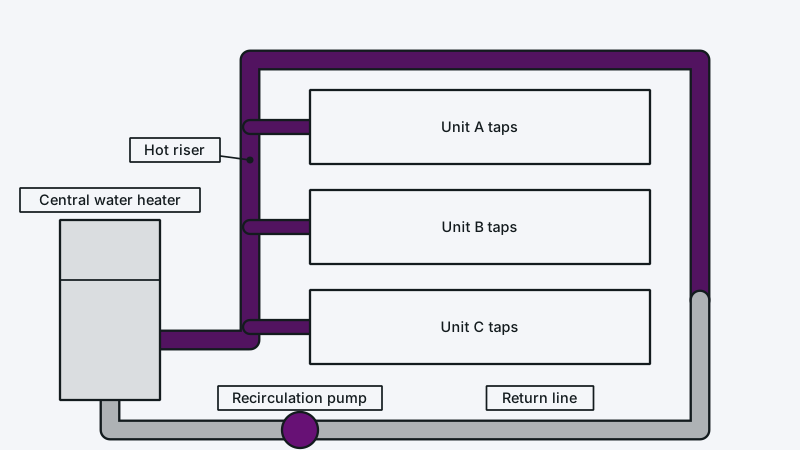
Most often the building's shared water heater or boiler has stopped: a gas supply fault, a failed ignition, a tripped breaker, a failed pump, or a tank leak. Sometimes the heater is fine and the circulation line, a mixing valve or a controller has failed. One unit alone without hot water more likely has a problem with its own heater.
Common causes in multi-unit buildings:
- Central heater or boiler down. Gas interruption, a failed gas valve, a safety lockout or no power to the control board.
- Circulation pump failure. Many buildings keep hot water moving through a loop. If the pump fails, upper units may wait a long time or never get hot water.
- Mixing or tempering valve fault. The valve that blends cold into hot to limit temperature can stick and block the hot side.
- Scale and sediment. In large tanks, buildup cuts capacity and heating.
- A shutoff left closed. After work on the building, a valve may not have been reopened.
- Gas service problem. A utility shutoff, or a meter problem, affects every gas appliance.
Older Burbank and Valley apartment buildings from the postwar decades often have a boiler room or rooftop heater with piping that has been patched several times. A plumber asked to look at a building heater will check gas pressure, the pilot or igniter, the pump, the mixing valve and the circulation loop in turn.
A gas smell anywhere in the building means everyone gets out, and someone calls SoCalGas (1-800-427-2200) from the street, or 911 when there is a hazard.
Is a landlord required to provide hot water in California?
Yes. California Civil Code section 1941.1 lists conditions that make a dwelling untenantable, and one is a water supply under the landlord's control that does not produce hot and cold running water to the appropriate fixtures. Section 1941 requires landlords to repair conditions that make the dwelling untenantable. Treat this as general information and not as legal advice.
What tenants can do, in order:
- Write to the landlord or manager. A text, email or letter works if it carries the date. Hold onto a copy. Describe which units and fixtures have no hot water.
- Allow a reasonable time. Under Civil Code 1942, a tenant who repairs and deducts after the 30th day from notice is presumed to have acted within a reasonable time, though shorter periods can be reasonable depending on the circumstances.
- Know the limits of repair and deduct. The cost cannot exceed one month's rent, the remedy can be used only two times in any 12 months, and it is not available if the tenant caused the problem.
- Contact the city. If the landlord does not act, the local code enforcement office can inspect. Burbank addresses go to the city's code enforcement, while addresses inside Los Angeles city fall under that city's housing department.
- Speak to a tenant organization or a lawyer before withholding rent, since the rules are strict.
Repair and deduct is a legal remedy with conditions. A tenant should not attempt plumbing work on a shared gas heater. That work belongs to a contractor.
What should an owner or manager do when the building has no hot water?
Contact a plumber at once, tell residents what is happening and when to expect an update, and keep a log. Shut the heater off if you smell gas or see a leak. A building heater is larger than a house tank, so a plumber should handle the diagnosis, any gas work and any permit.
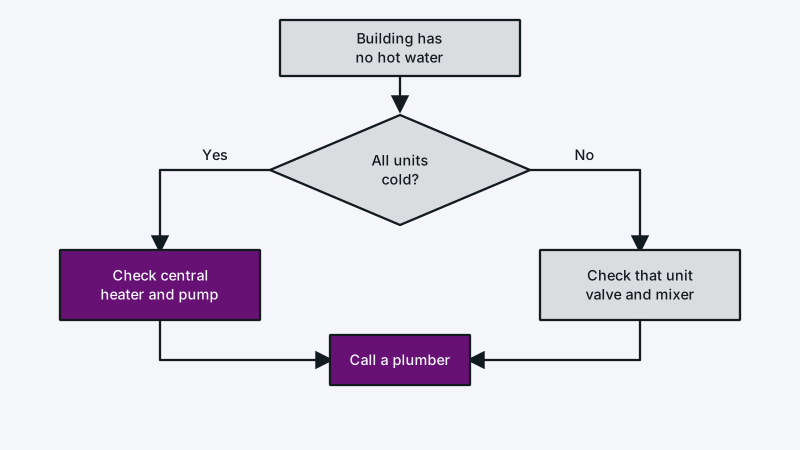
A useful sequence:
- Check basics in minutes. Is the heater powered, is gas on, are valves open, is there a lockout light or error code?
- Call a plumber with commercial or multi-family experience. Say how many units are affected, the heater type and age, and any codes shown.
- Post a notice. Tell tenants the cause, the plan and when you will update them.
- Offer a stopgap if repair will take time. Some owners arrange temporary access to showers or hot water heaters. Check what your lease and local rules require.
- Plan the permanent fix. An old building whose heater has already failed once may have a unit on its last legs. Replacement of a central unit needs permits, gas and venting checks and sometimes structural work.
Water heater replacement and any change to gas piping typically need a permit. Check with the building department for your address, which is the Burbank Building Division, Glendale Building and Safety or LADBS. For a general picture of that process see permits for a water heater. Where individual units have their own tanks, the replacement path is the same as for a house, covered in hot water heater replacement. Some buildings move to tankless water heaters, one per unit, which changes the gas and venting work.
How do I get hot water back fast, and is there a health angle?
Get a plumber to the shared heater the same day and keep the hot water temperature in a safe range once it is restored. Wikipedia notes that guidelines recommend storing hot water at 60 C (140 F), with at least 50 C (122 F) reached at the points of use, to control Legionella, while very hot water scalds in seconds.
That balance is why a plumber checks the mixing valves when restoring a building system. Heating a large tank back up, then reaching the target temperature across the building, can take hours. If the system stood cold for a while, ask the plumber whether the loop needs flushing.
Residents can help in these ways:
- Report which units and fixtures have no hot water, not just the building as a whole.
- Avoid running hot taps for long periods in a way that drains the loop and delays the recovery.
- Keep a record of the dates and times for any later rent dispute.
An owner who wants to understand the quote can look at how often a water heater should be replaced and the cost pages. Send a quote request and a local tradesperson is arranged to visit, with a written price before work starts. More on our service is on the Lankershim Plumbing home page. We can also arrange help with emergency water heater repair when it is urgent.
Questions people ask
How soon can hot water return to an apartment building?
A minor fault like a tripped breaker, a pilot light or a stuck valve may take just an hour or two to fix after the technician arrives. A failed pump, valve or control board may need a part ordered. A failed boiler or tank means replacement, which takes a day or more plus permits. Only after an inspection can the plumber offer a firmer estimate.
Which questions go to a contractor for a building with no hot water?
Ask whether they work on multi-unit and commercial-size heaters, what they will check first, and how fast they can come. Get the diagnosis and repair priced on paper, and find out if a permit applies. Confirm the California contractor license at cslb.ca.gov ahead of the work. Ask what happens if a part has to be ordered.
Does anyone have to be present during the repair?
The owner, manager or a key holder has to let the plumber into the boiler room or heater area, and may need to enter individual units to test fixtures. Residents should be told in advance. If the problem is in one unit only, the tenant should be present or give written permission for entry.
Can a tenant fix the water heater and deduct the cost from rent?
California Civil Code 1942 allows repair and deduct in limited cases: written or oral notice, a reasonable time, a cost not above one month's rent, and at most two times in 12 months. Work on a shared gas heater is not something a tenant should do. Get legal advice before withholding or deducting rent.
Who do I call if there is no hot water and my landlord does not respond?
Start with a written notice to the landlord or manager, and retain a copy. If nothing happens, contact the local code enforcement office, such as the City of Burbank, or the housing department for your city. A tenant rights group or a lawyer can explain your options. In an emergency or a gas smell, call 911 and SoCalGas.
References
- California Civil Code 1941.1, untenantable dwelling (FindLaw)
- California Civil Code 1942, tenant repair and deduct (FindLaw)
- California Civil Code 1941, landlord duty to repair (FindLaw)
- Wikipedia, Water heating (Legionella and storage temperatures)
- Bob Vila, no hot water causes and fixes
- SoCalGas, if you smell gas
Updated