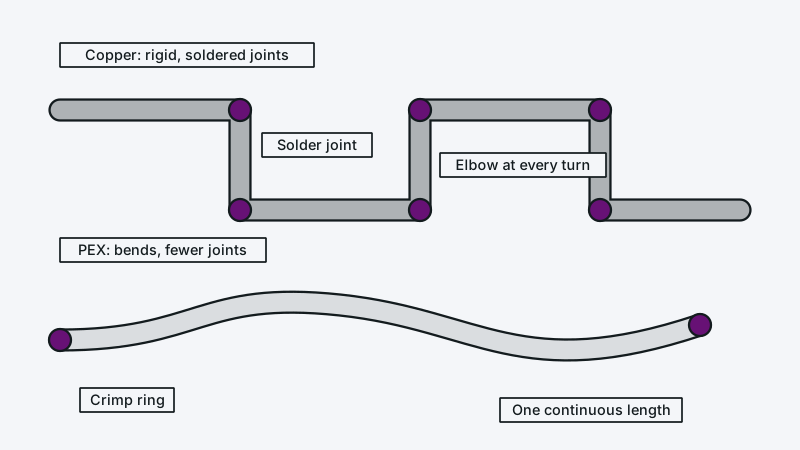
For most Burbank repipes the choice comes down to budget and where the pipes run. PEX costs less, goes in faster and bends through walls. Copper has a longer track record, takes heat and sunlight, and suits exposed runs. Both are approved in California, both need a permit, and both can last for decades. Our repiping overview covers the job, and you can ask for a priced comparison on the quote page.
How do PEX and copper compare on cost?
PEX is the cheaper material. A national guide lists PEX tubing at about $0.40 to $2 per linear foot and copper at $2 to $8, with whole-house repipes spanning roughly $1,500 to $15,000. Copper also costs more to install, because rigid pipe takes more connections and more room to work. Southern California quotes may run higher than these national numbers.
| PEX | Copper | |
|---|---|---|
| Tubing cost, per linear foot (national guide) | $0.40 to $2 | $2 to $8 |
| Service life (national guide) | 80 to 100 years | 50 to 100 years |
| Joints | Fittings with rings or expansion | Soldered or pressed |
| Sunlight | Must be shielded | Fine |
| Freezing | Typically more burst-resistant | Can split |
| Where it shines | Wall fishing, fewer joints | Exposed runs, long record |
Service life numbers are estimates, and water chemistry and workmanship change them. See the PEX repipe cost page for a breakdown by item.
Which lasts longer, PEX or copper?
Both can last decades. The national cost guide gives copper 50 to 100 years and PEX 80 to 100, but those are ranges from a single source, not promises. In practice, the lifespan of either one depends on water chemistry, installation quality, pressure and temperature. Failures usually start at joints, fittings or places where the pipe was stressed or exposed.
Copper's most common failure is corrosion. Reference sources name three causes: pitting from contamination such as soldering flux, erosion from fast, turbulent flow, and stray electrical current from poor grounding or bonding. PEX does not corrode, but it can fail where it was kinked, over-tightened or left in sunlight. Our page on copper pipe leaks explains how those start.
Does water quality in the San Fernando Valley change the choice?
Yes, it can. Hard water leaves scale inside copper, and reference sources say mineral deposits in hard water tend to coat the pipe and reduce exposure. LADWP also notes that a drop in pH can cause copper to leach from brass and copper pipe. Water in the Valley comes from several sources, and each city utility publishes its own report.
In 2022 LADWP put Valley hardness near 8.6 grains per gallon on average. Burbank Water and Power and Glendale Water and Power publish reports for their customers, so read yours before deciding. PEX does not scale or corrode, and sources note PEX includes antioxidants that stabilize it against chlorine. If your reports show aggressive water, tell the plumber and ask for a view.
How do PEX and copper compare on flow rate?
At the same nominal size, PEX generally has a slightly smaller inside diameter than copper, so plumbers often size PEX up or use a home-run manifold layout to keep flow at distant fixtures. We aren't printing a flow chart from memory. Manufacturers publish inside diameters, and a plumber sizes the system from your fixture count and pressure.
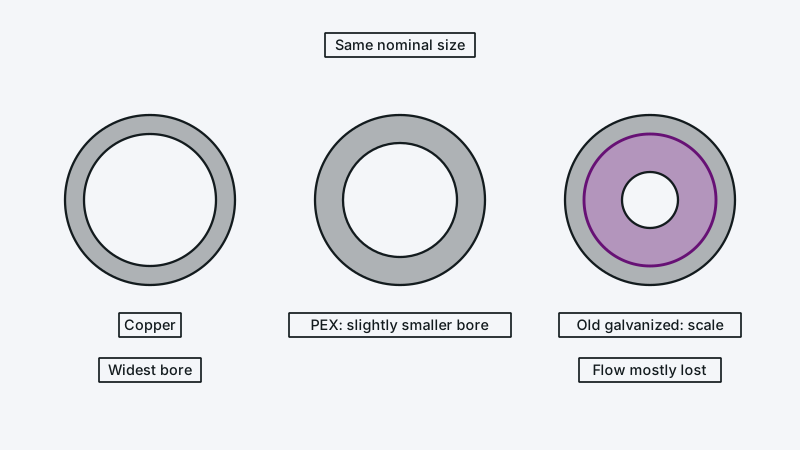
For half-inch lines to single fixtures, the difference is rarely noticeable in a home. It matters more on long runs and where several fixtures run together. Old galvanized steel has usually lost much of its flow to rust and scale, so either new material feels like a large improvement.
Does PEX or copper handle freezing and cold weather better?
Reference sources call PEX more burst-resistant than copper or PVC in a freeze, mainly because it is flexible. Copper can split when water freezes inside it. Burbank rarely sees hard freezes, so this seldom decides a repipe here. It matters more for foothill homes, outdoor runs, detached garages and cold nights at higher elevations.
Insulation helps either material. If you want a longer answer for your own conditions, our page on whether PEX freezes and bursts goes into it. Heat and sun are the Valley's bigger problem for plastic pipe, so exposed attic runs need shielding.
Is PEX safe for drinking water?
California approved PEX in its Plumbing Code with adoption effective August 1, 2009, after a period of disputes over health and performance, and PEX is now allowed in all occupancies. Reference sources estimate it is used in about 60 percent of single-family homes in the United States. If you have concerns, ask for the manufacturer's documentation for the tubing you are being quoted.
Copper has its own water-quality question. Lead solder has been barred from drinking water systems since 1986, and federal rules cap lead in solder and flux at a weighted average of 0.2 percent. LADWP says solder issues should be minor in homes built after 1990. In older homes, a lead test, usually $20 to $100, is the sole way to find out.
What about CPVC, or mixing PEX and copper?
CPVC is a rigid plastic that costs about $0.50 to $1 per foot in the national guide, with a service life listed at 50 to 70 years. It can be a budget option. Mixing is common: many repairs join PEX to existing copper with approved transition fittings, which are made for that purpose.
Where new copper meets old galvanized steel, LADWP warns that direct contact makes the steel rust faster and recommends a dielectric coupling. Ask the plumber how every transition is handled. A repair that keeps old galvanized pipe in service is covered on our galvanized pipe replacement page.
How do you choose between PEX and copper?
Choose PEX if budget and speed lead, if walls are finished and routing is tight, or if you want a material that doesn't scale or corrode. Choose copper if you have long exposed runs, want a material with a long record, or prefer rigid pipe. Ask for both options priced on the same scope. Then compare the written quotes.
Check the contractor license before you sign. The $1,000 license threshold and the permit rule both apply, and plumbing is the C-36 classification. Pull the plan together with our guide to how to repipe a house, and see PEX A versus B if you pick PEX.
Questions people ask
Which is quicker to install, PEX or copper?
PEX, in most houses. It bends around corners and joins in seconds with a tool, while copper is cut, cleaned and soldered or pressed at every joint. That time shows up in labor cost. The gap narrows on short, straight, open runs. Either way the permit inspection comes before the walls close and sets the finish.
How do I compare a PEX quote and a copper quote?
Ask both plumbers to cover the same scope: same fixtures, same patching, same permit. Then compare tubing, fittings, labor and extras line by line. Be wary of a copper quote that doesn't say whether joints are soldered or pressed, and a PEX quote that doesn't name the type. Same scope, same words, then compare.
Do I need to decide the material before the plumber visits?
No. A plumber can see the house and price both options. Know your priorities first: budget, wall access, exposed runs and your water report. Then ask which material they would choose for your house and why. A good answer refers to your attic, your walls and your water, not a general preference.
Does copper pipe cause pinhole leaks?
It can. Reference sources name pitting from soldering flux, erosion from fast flow and stray electrical current from poor grounding as common causes. If you have more than one pinhole leak, the plumber needs to examine the cause, including grounding, water chemistry and pressure, before deciding between repair and repiping. Repeat leaks are a common reason homeowners move to a full repipe.
Every service and price guide is on plumber across Burbank.
References
- Cost to repipe a house, material cost and service life
- Cross-linked polyethylene, freezing, UV, chlorine, California approval (Wikipedia)
- Copper tubing, corrosion and lead solder (Wikipedia)
- Plumbing, copper and PEX in homes (Wikipedia)
- LADWP water quality FAQs
- California Contractors State License Board, what kind of contractor do I need
Updated