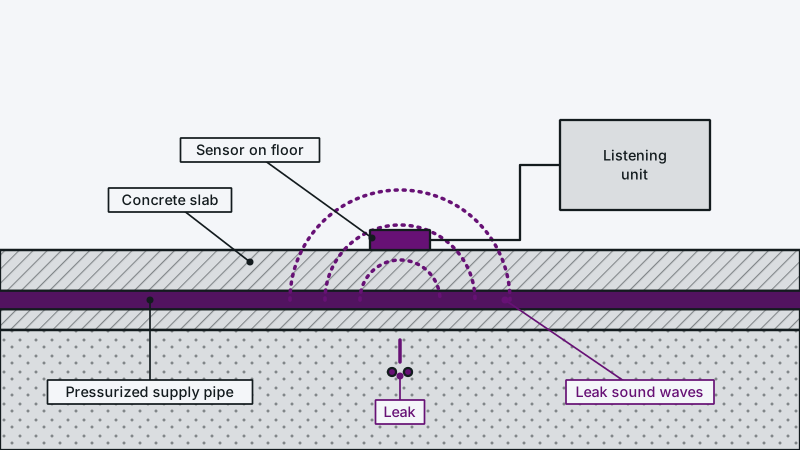
Acoustic leak detection means listening to your plumbing with sensitive microphones and amplifiers to find where pressurized water is escaping. A leak that has no visible sign, buried inside a wall or beneath a slab, still makes a hiss or hum that travels along the pipe and through the ground. This page is part of the wider guide on leaks and burst pipes.
How does acoustic leak detection work?
Water leaking from a pipe under pressure makes noise, and the pipe and the surrounding material carry that noise. A technician places a contact sensor on a pipe, valve or fitting, or a ground microphone over the floor, and listens for where the sound is loudest. The loudest point is the best clue to the leak.
Wikipedia's overview of leak detection describes the same idea on a bigger scale: sensors on the outside of a pipe build a baseline of normal noise, and ground microphones can pinpoint underground leaks because an escaping pressurized water jet underground makes a faint noise. In a house the instruments are smaller, but the logic is the same.
A typical home visit has three parts:
- Shut off everything that uses water. Every tap, the dishwasher, the washer, the ice maker and the irrigation. Background flow drowns out the leak.
- Listen at access points. The plumber puts the sensor on the meter, the main shutoff, accessible valves and fixtures, and notes the sound at each.
- Walk the floor with the ground microphone. For a suspected slab or yard leak, the sound is traced along the likely pipe route until the loudest spot is found.
The aim is to open as little as possible. A pinpointed spot means a small hole in a slab or wall instead of a trench or a wall cut open along its length.
What is ultrasonic leak detection, and is it different?
Ultrasonic detection listens at frequencies above human hearing, usually with a handheld probe that converts them into audible tones or a display. It is often used on air, gas and pressure lines, and as a cross check on accessible water pipes. In practice, many home plumbers carry one tool set that covers both audible and higher range sounds.
For searches about ultrasonic leak detection equipment, here is the plain version. Ultrasonic probes are good at short range, with the tip close to the pipe, valve or joint, and in quiet surroundings. Acoustic ground microphones are better for tracing a buried line over a distance. The two are partners, not rivals, and a competent plumber picks by the situation, not by what is in the truck.
Neither tool is a magic wand. Both depend on a pressurized leak that is making noise. They need a plumber who knows how to read the sound, because a running toilet, a pump, a noisy neighbor's irrigation or a pipe knocking against a stud can all mimic a leak.
When does acoustic leak detection work best, and when does it struggle?
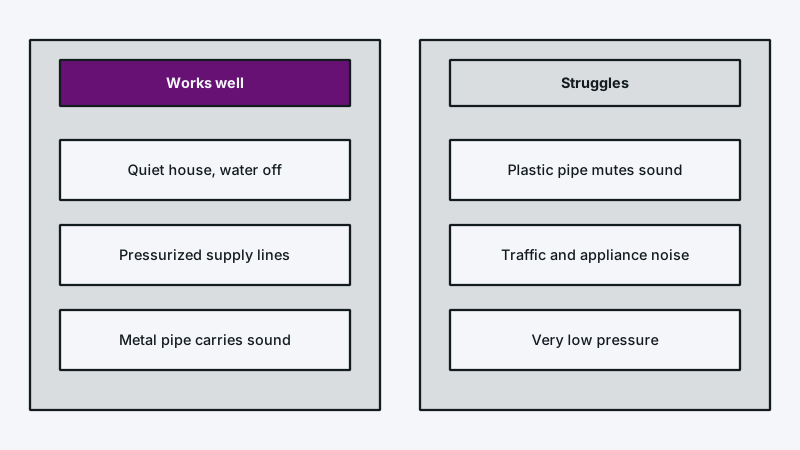
It works best on pressurized water supply lines that are leaking steadily, in a quiet house, with the water use shut off. It struggles with very small leaks, plastic pipe that carries sound poorly, noisy environments, deep or wet ground that muffles noise, and drain pipes, which are not pressurized and leak quietly.
Things that help:
- Steady pressure. Higher pressure makes a louder leak. Finding a leak on the feed to a toilet or hose bib is easier than one with almost no flow.
- Metal pipe. Copper and galvanized steel carry sound well. Many tract houses in Burbank and the San Fernando Valley built between the 1940s and 1960s contain one or both, with copper repairs mixed in.
- A quiet moment. Early morning or late evening, with the street quiet and the neighbors' sprinklers off.
Things that make it harder:
- Plastic and PEX. Sound dies faster in plastic. A plumber may add a second method, such as pressure testing or thermal imaging.
- Thick slab or wet soil. Both muffle sound and spread it out, which can leave a wide area of doubt.
- Drain and sewer leaks. They are low pressure, so a different method, such as a camera inspection or a dye test, is better.
- Multiple leaks. One loud leak can hide a quiet one. Ask the plumber to recheck after the first repair.
Should a slab leak be the worry, our pages on slab leak detection and underground water leak detection. For a quick check that comes before any call, our guide to leak detection with your water meter shows what you can do yourself in a few minutes.
What should I do before I book acoustic leak detection?
Confirm there is a leak first. EPA WaterSense says to read your water meter before a two hour period when no water is used, and read it again afterward. If the reading changed at all, you probably have a leak. The check is free, settles whether a call is needed, and is the first thing a plumber will ask about.
Then gather the facts the plumber will ask about:
- When you first noticed it. A jump in the bill, floor that feels warm underfoot, noise inside a wall, weak pressure, a damp smell.
- Where the main shutoff and meter are. Keep the path clear.
- The age and material of your pipes, if you know them.
- Anything you have already done, such as shutting valves or patching.
Tell the plumber about a pressure regulator or water softener too, since either changes how the system sounds. EPA WaterSense also reports that the average household loses about 9,400 gallons a year to leaks, and that about 9 percent of homes lose 50 gallons a day or more, so a leak you can hear is worth chasing.
How much does acoustic leak detection cost?
No sourced price is available, and we will not make one up. Cost depends on the size of the property, the number of access points, whether a slab or a yard is involved, and how much follow-up is needed. The plumber visits first and quotes afterward, and that quote ought to state the outcome when no leak turns up.
Ask these questions when you book:
- Is the detection a flat fee or charged by the hour?
- Does the fee count toward the repair when the same plumber does it?
- What is the plumber going to deliver: a marked spot, a report, photos?
- When the leak sits beneath a slab or behind a wall, who closes up the opening?
Start at the quote page to get a visit scheduled. To see what repairs run on and how quotes are built, read about plumber leak repair cost.
More plumbing help for the Valley sits on the Lankershim Plumbing home page.
Questions people ask
Does acoustic detection work for slab leaks?
Frequently, as long as the leak is on a pressurized supply line and makes noise. The plumber listens at fixtures and walks the floor with a ground microphone to find the loudest point. Results are best on metal pipe and in a quiet house. A second method may confirm the spot before anyone breaks concrete.
Is acoustic leak detection accurate?
The method can shrink the search to a small area, though accuracy hinges on pipe material, the noise around it and the plumber's skill. Plastic pipe and wet soil blur the sound. Good practice is to confirm the spot with a second clue, such as a pressure drop or a moisture reading, before cutting anything open.
Does it damage anything?
No. The sensors sit on pipes, valves and floors, and nothing is cut or drilled to listen. Damage only comes later, when a leak is found and a repair needs an opening. The goal of the listening step is to keep that opening as small as possible.
Can it find a gas leak or a drain leak?
Not reliably. Acoustic methods are meant for pressurized water lines. Drain and sewer lines are not under pressure, so camera inspection or dye tests fit better. Gas leaks are a safety matter: a gas smell means getting out of the building and calling SoCalGas on 1-800-427-2200 from outdoors. Never try to trace gas by ear.
Must I be there for the visit?
An adult should be present to admit the plumber, point out the meter and main shutoff, and approve any opening that proves necessary. You will also need to avoid running water during the listening. Plan for a quiet house, which means no laundry, no dishwasher and no irrigation.
References
Updated