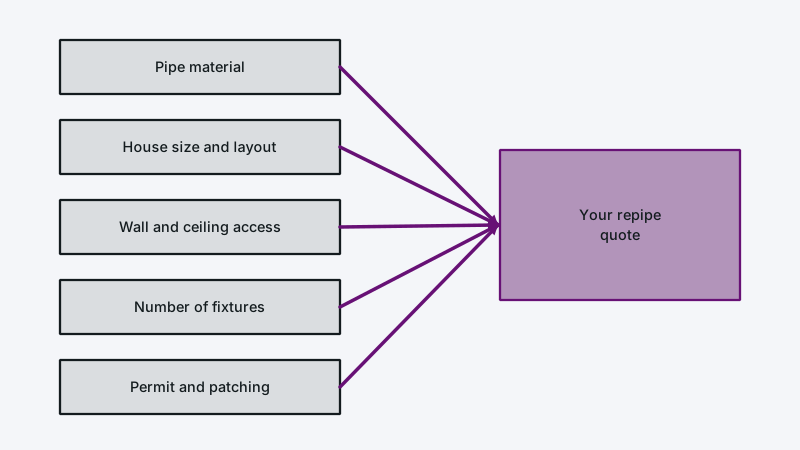
Repiping a house costs about $7,500 on a national average, within a range of roughly $1,500 to $15,000. In Burbank and the Valley, bigger homes, two stories and slab foundations push toward the top of that range, and Southern California labor and drywall repair can add to it. The numbers below are a guide. The figure to trust is the written quote issued once a plumber has been through the house, and you can request one through the quote page. For the job itself, see the repiping overview.
How much is a full house repipe?
A national guide puts a whole-house repipe at about $7,500 on average, with a range of about $1,500 to $15,000 depending on size, material and access. Many quotes list the permit, inspection and wall repair as separate items. These are planning figures, and Southern California quotes can come in above the national numbers.
| Item | National guide |
|---|---|
| Whole-house repipe, typical range | $1,500 to $15,000 |
| Whole-house repipe, average | about $7,500 |
| PEX tubing, per linear foot | $0.40 to $2 |
| CPVC tubing, per linear foot | $0.50 to $1 |
| Copper tubing, per linear foot | $2 to $8 |
| Permits | $50 to $500 |
| Inspection | $250 to $1,200 |
| Replacing the water main | $600 to $2,500 |
These figures come from one national cost guide, and we have not seen a Burbank price list that breaks them out. When quotes arrive, compare them line by line against this table.
How much do plumbers charge to repipe a house?
Plumbers price a repipe as a job, not by the hour, because the work depends on the house. The national guide estimates labor around 15 hours for a standard home, or roughly $675 to $3,000. The rest of the quote is materials, permit, inspection and patching. A solid quote itemizes all of these, names the pipe material and says who repairs the drywall.
Two quotes for the "same" repipe can differ by thousands for ordinary reasons. One may include drywall patching and paint touch-up and the other may not. One bid might use PEX with a manifold while another uses copper with soldered joints. One may swap the shutoff valves and hose bibbs where the other keeps the old ones. Have every plumber price an identical written scope.
What does a repipe cost per square foot, or for a small house?
One national example prices a three-bedroom, 1,500 square foot house at $2,280 to $5,120, which works out to roughly $1.50 to $3.40 per square foot. Treat per-square-foot math as a rough sanity check only. Fixtures drive the pipe count, so a compact house with three bathrooms can cost more than a bigger one with a single bath.
Why not a calculator? A real estimate depends on bathroom and fixture counts, the floors, the foundation type, your chosen pipe material and how simple it is to reach the attic or crawl space. A web form sees none of that. Plan with the ranges, then book the walk-through. Condos and mobile homes differ again: the national guide gives $1,500 to $4,000 for a mobile home.
What makes a Burbank repipe cost more?
Four factors lift the price the most. Access leads: a slab-on-grade house, a second story or a finished attic all mean extra cutting and patching. Fixture count comes next, as every bathroom, kitchen and laundry adds runs. Then there is the old pipe, since pulling out and disposing of galvanized or aged copper takes time. Last are the permit and inspection in your city.
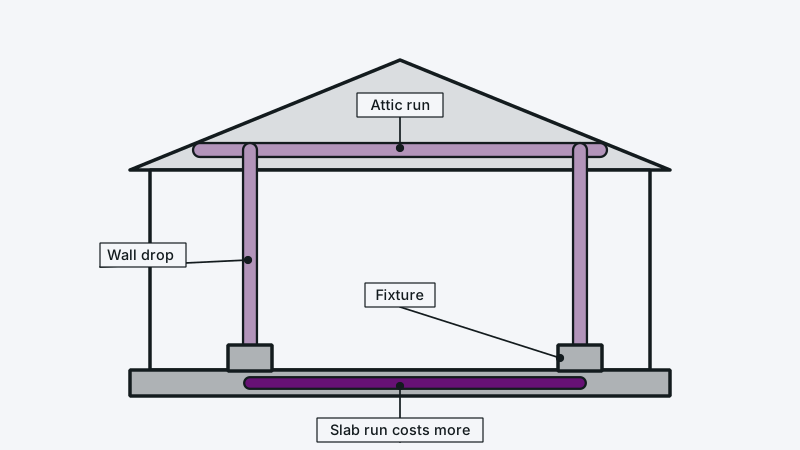
Local conditions count as well. A lot of Valley homes date from the 1940s through the 1960s, and Burbank housing is on the older side, with over 62 percent built before 1970. Foothill hillside homes can make access awkward. Burbank Building Division, Glendale Building and Safety and LADBS set the permit steps, so a house just across a city line may be handled differently.
How often do house water pipes need to be replaced?
It depends on the material. Galvanized steel was common in American potable water systems until about 1960 and lasts roughly 30 to 50 years. LADWP puts galvanized at about 20 years on average before rust appears, up to 40 for well-made pipe. The national guide gives copper 50 to 100 years, PEX 80 to 100 and CPVC 50 to 70.
Treat these as service-life estimates rather than promises, since water chemistry, installation quality and temperature all move the real figure. LADWP's 2022 report has Valley hardness averaging near 8.6 grains per gallon, and hard water leaves scale behind. Seeing leaks or discolored water? Read why people repipe a house and the signs of galvanized pipe failure.
How hard is it to repipe a house?
This is skilled plumbing work with a permit and inspections, and a homeowner should not take it on without the right license. A contractor license is mandatory in California once labor plus materials reach $1,000, or whenever the job needs a permit. Plumbing sits in classification C-36.
For the plumber, difficulty mostly comes down to access and finish work. A roomy attic plus a crawl space keep it routine, and tight walls, tile showers and slabs slow it. Those details decide whether your quote says a day or a week, and how long a repipe takes covers the schedule.
Can you replumb a house without removing walls?
In most cases yes, though some openings are unavoidable. PEX can be fished through walls using small cuts at fixtures, and lines can also travel via the attic or crawl space. That approach costs mostly patching, not demolition. Ask how many holes the plumber expects, where they fall and who repairs and paints them.
Your choice of material affects access cost. PEX installs faster than rigid copper, a main reason it is often cheaper. The price gap is examined on our PEX repipe cost page and the PEX versus copper page.
Questions people ask
Does repiping a house add value?
Mostly it preserves value. Fresh supply lines clear up a common inspection flag on older homes and head off water damage that would lower a sale price. They seldom lift the price the way a remodeled kitchen does. Planning to sell? A repipe with a final permit sign-off hands buyers a clean record. Your agent can say how local buyers view galvanized plumbing.
What devalues a house the most?
The costly problems that are hard to see: foundation movement, roof failure, unpermitted work and water damage. Aging plumbing makes the list because a hidden leak can cause rot and mold, and buyers mark prices down for unknowns. Of that group, old supply pipes are among the easier to fix, at a cost you can get quoted before listing.
Why does a repipe quote vary so much between plumbers?
Scope is the answer. A quote may bundle permit, drywall repair and paint, or leave them out. Material matters as well, since PEX, CPVC and copper cost very different amounts per foot. Hand each plumber the same written scope and compare matching items. A quote naming permit, inspection, pipe type and patching deserves more trust than a lone total.
For what the work involves beyond the price, see plumber in Burbank.
References
Updated