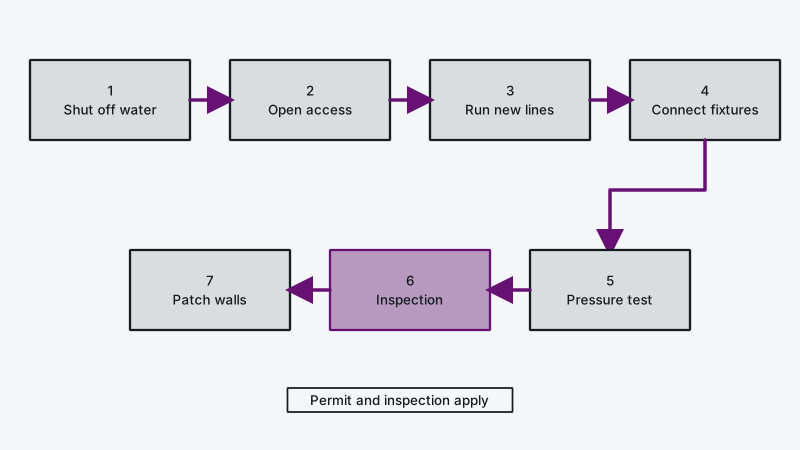
Plumbers repipe a house in a fixed order: shut off the water, plan the routes, open small access points, run new tubing to each fixture, connect it, pressure test, get the permit inspection, then patch the walls. A whole house repipe is not a DIY job in California, because the work requires a permit and a contractor license. The steps below show what the process looks like. For a quote, use the quote page.
How do they repipe a house, step by step?
The plumber walks the house, counts fixtures and decides the routes. Then the water is shut off at the main, the old lines are cut out or abandoned, and new pipe is run, usually from the attic or crawl space down to each fixture. Fixtures are reconnected, the system is pressure tested, the inspector signs off, and the access holes are patched.
Behind that outline, the work flows in a few stages. Protection comes first: floors are covered and furniture moved. Access holes come next, small ones at each fixture and in closets. The new main line and distribution tubing follow. Then come shutoff valves and fixture stubs, a leak test, and the inspection. Finally the drywall person patches the holes, and paint finishes the job.
How is a PEX layout different from copper?
PEX is usually laid out in one of two ways. A trunk and branch layout uses a main line with smaller lines splitting off, much like copper does. A home-run layout runs a separate line from a central manifold to each fixture. The manifold makes each fixture independently shut off and can keep pressure steadier when two fixtures run together.
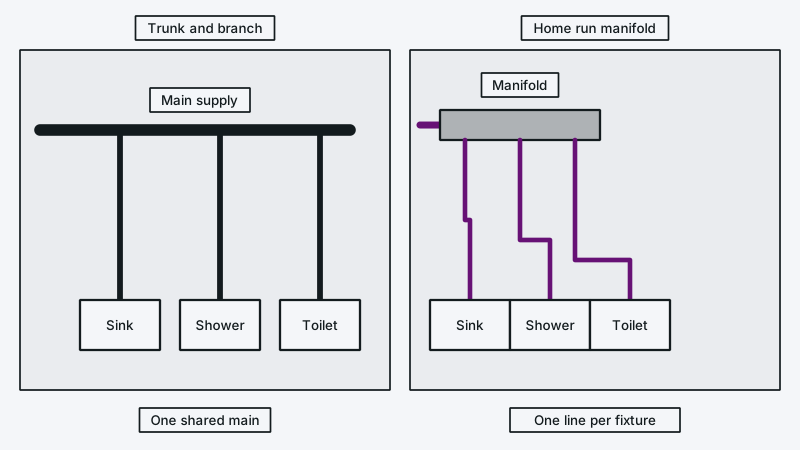
A rough diagram: the water enters at the meter, passes the pressure regulator if the house has one, feeds the water heater, and then reaches the manifold or trunk. Hot and cold lines leave from there. Home-run layouts use more tubing but fewer joints inside walls. Ask which layout the plumber proposes and where the manifold will sit, since it needs an accessible spot and a place to shut it off.
Can PEX be run without opening many walls?
Mostly, yes. PEX bends, so the plumber can fish it through wall cavities, attics and crawl spaces with small access holes instead of demolishing walls. Fittings are mechanical, with crimp rings or expansion connections. Copper needs more room and more connections. Either way, some drywall repair is normal, and a good quote says who does it.
PEX also has handling rules. Direct sunlight for as little as 30 days may cause embrittlement, so tubing shouldn't be left exposed in an attic gable or on a roof. Plumbers use sleeves or protective supports where lines pass through framing and metal.
How do you repipe a house on a slab foundation?
Slab homes have supply lines buried in or under the concrete. Plumbers usually avoid cutting the slab. The common approach abandons the old lines in the concrete, caps them, and runs new pipe overhead through the attic and down the walls to each fixture. That means more ceiling and wall access, but no jackhammer.
It is a different path from a raised-foundation house, where the plumber works from the crawl space. Slab jobs can cost more because of the overhead routing and extra patching. If your problem is one leak under the slab, ask about a spot repair first. Our page on slab leak repair or repiping explains how to decide.
How often should you repipe a house?
There is no set interval. Repipe once the material is close to the end of its life or is failing. Galvanized steel in potable water has a service life of roughly 30 to 50 years, so a house from the 1950s or earlier is usually well past it. The national cost guide gives copper 50 to 100 years and PEX 80 to 100.
Condition matters more than age. Rust-colored water, falling pressure, and leaks at several places point toward replacement. A single leak does not. LADWP's own estimate for galvanized is about 20 years to first rust, and up to 40 at best. If your plumbing is copper from the 1960s through 1980s and is leaking at pinholes, ask for a cause before replacing.
Can a homeowner repipe their own house?
Not legally in most practical cases. Under California rules, work worth $1,000 or more in labor and materials needs a license, as does any job requiring a building permit, and CSLB says a permit is needed to alter or repair a structure. Owner-builder rules exist under the Business and Professions Code, but they carry duties and risks that CSLB warns about.
Even where you are allowed, a repipe is a long, technical job with a real risk of hidden leaks, bad connections and failed inspections. Water damage inside walls can cost more than the repipe. Many owners choose to do the patching and painting themselves and leave the plumbing to a contractor. Ask the plumber if that split is acceptable.
What do you need to know before the plumber arrives?
Know what pipe you have now, where the main shutoff is, and where the water heater and fixtures are. Clear access to closets, under sinks and the attic hatch. Plan for water being off during the day. Decide whether you want copper, PEX or another material, and whether you want drywall patched and painted by the plumber or by someone you hire.
Think about the schedule too. Most houses take a few days, with the permit inspection setting the pace. Timing is covered in our piece on replacing galvanized pipe, and for material choice see PEX versus copper. Our repipe cost page shows the national ranges. Burbank, Glendale and LADBS each handle permits, so confirm where yours goes.
What to do next
Photograph your main shutoff, water heater and the pipes under two sinks. Note any low-pressure fixtures. Then gather a written quote that names the material, the layout, the permit and the patching. Compare more than one. More repair guides start from the Lankershim Plumbing home page.
Questions people ask
How long does each stage of a repipe take?
Running tubing is the longest stage, followed by connections and testing, then the inspection and patching. Total time is a few days for an average house, and the inspection slot can add waiting. Get dates for each stage written into the quote, and ask what happens when the inspector cannot make the planned day.
What happens if the plumber finds a surprise in the wall?
Older houses often hide rotted framing, old galvanized stubs or earlier unpermitted work. A solid quote spells out how changes get priced and approved before work goes on. Have any added cost put in writing first, along with photos of the discovery.
Can I stay in the house during a repipe?
Generally yes, though expect dust, noise, open walls and the water shut off for stretches of the day. Some families stay elsewhere when there are young children or health needs. Ask the plumber when the longest shutoffs fall and where the access holes will be, so you can plan where to cook, bathe and sleep.
Is a PEX repipe diagram the same for every house?
No. Layouts depend on where the meter, water heater and fixtures sit, and on whether the plumber uses a trunk and branch or a home-run manifold. Any diagram you find online is a general picture. The plumber's plan for your house is what the inspector will check, so ask to see where lines and the manifold will run.
References
- Plumbing, materials and service life (Wikipedia)
- Cross-linked polyethylene, fittings, UV and freezing (Wikipedia)
- Cost to repipe a house, labor and service life
- California Contractors State License Board, what kind of contractor do I need
- California Contractors State License Board, building permit requirements
- City of Los Angeles Department of Building and Safety
- LADWP water quality FAQs
Updated