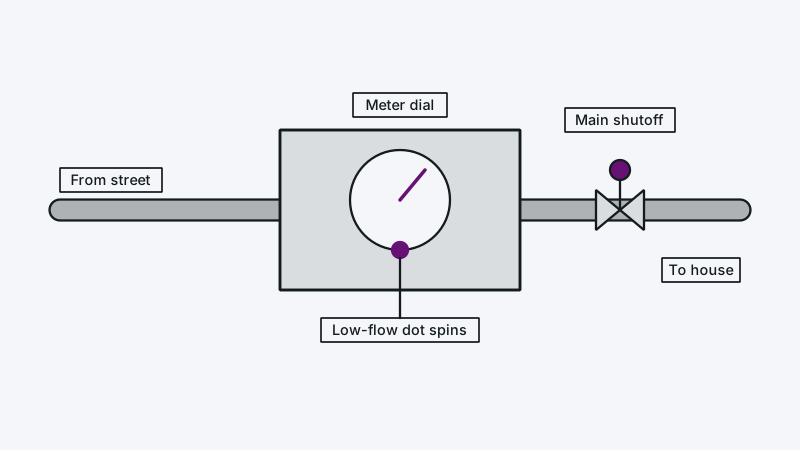
Shut off every water use in the house, read your water meter, wait, and read it again. If the numbers moved, water is going somewhere, and you have a leak. That is the method EPA WaterSense gives for a home leak check. This page shows the steps, how to narrow the leak to a spot, and the point at which a plumber is needed. It belongs to our wider coverage of leaks and burst pipes.
How do I check for a leak with my water meter?
Shut off all use for two hours, note the meter reading at the start and end, and compare the two. EPA WaterSense says that if the reading changed at all, you probably have a leak. A faster version is to watch the small leak indicator on the dial for a minute with everything off, since many meters have one that spins with even a tiny flow.
The two hour version, step by step:
- Stop every use. No laundry, no dishwasher, no irrigation, no ice maker cycle, no one flushing. If you have a water softener or a recirculating hot water pump, note it. They can use water on a schedule.
- Find the meter. It is usually in a lidded box near the curb or the front of the lot. Lift the lid carefully, since insects and debris can live under it. Do not turn any valve inside unless your utility allows it.
- Write down the reading, including every digit, and a photo helps. Note the position of the leak indicator, the small dial or triangle that turns when water moves.
- Wait two hours without using water.
- Read it again. A change is a leak. No change means the house is tight, at least for now.
A quick check takes a minute: with water off, watch the indicator. If it turns, water is moving. Different meters look different, so if you cannot tell which dial is the indicator, ask your utility, or read the register digits twice, an hour or more apart.
How do I tell if the leak is in the house or the yard?
Close the main shutoff valve at the house and look at the meter again. A stopped indicator puts the leak indoors, beyond the valve. An indicator that keeps turning means the leak sits on the pipe run from meter to house, the section you own. The test narrows the search before anyone digs.
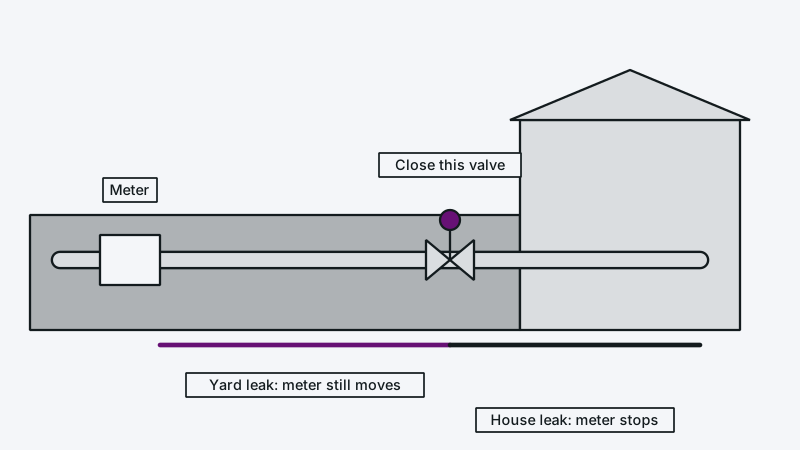
Why that works: the meter sits at the property line, and the shutoff is at the house. The pipe between them runs underground, often under lawn, driveway or planter. A leak there never shows inside the house.
Next steps by result:
- Stops when the main is closed: the problem is indoors or at a fixture. Check toilets, then taps, hose bibs, the water heater and any visible pipe. The next section covers where to look.
- Keeps moving with the main closed: the leak is underground between meter and house. Look for wet or sunken ground, a green patch in a dry lawn, or a damp driveway edge. Read our guide to underground water leak detection.
- Moves only when the irrigation is on, or only at certain times: check the sprinkler lines and valves. See sprinkler system leak detection.
If the leak sits under the slab, the sound and the pressure test are the next tools. We cover that in slab leak detection.
Where do leaks inside the house usually hide?
Toilets come first, then dripping faucets, showerheads, water heaters and supply lines under sinks. EPA WaterSense reports that an average family loses about 9,400 gallons a year to household leaks, and that a faucet dripping at one drop per second wastes over 3,000 gallons annually. Many of these leaks are cheap to fix.
A shorter checklist for the common culprits:
- Toilet flapper leaks. EPA's dye test: stir a little food coloring into the tank, hold off flushing for 10 minutes, and watch the bowl. Any color there points to a leaking flapper. Flush right after, so the tank does not stain.
- Faucets and showerheads. A drip is a leak. Fix the washer or cartridge.
- Hose bibs. Look for a drip at the spout and at the stem when it is on.
- Water heater. Check for rust, damp at the base and the pressure relief valve line.
- Flexible supply lines under sinks and behind toilets, which can seep for months.
- Ice maker and fridge lines, hidden behind the appliance.
Fix the easy ones, and read the meter again. If the movement stops, you have found it.
What do I do if the meter still moves and I cannot find the leak?
Bring in a plumber, who can locate it with sound, pressure or thermal tools. Tell the plumber what you learned from the meter, whether the leak goes away with the main closed, and how fast the indicator spins. That saves time and cost, because it tells the plumber where to start and what method suits the job.
Methods a plumber might choose:
- A pressure test, which isolates sections of pipe and watches for a drop.
- Acoustic listening, described on our page about acoustic leak detection.
- Thermal imaging, covered in infrared water leak detection.
Begin on our quote page, and we will set up a visit with a priced estimate in writing. Bring the meter numbers you took.
Your water bill can show a leak too. EPA WaterSense advises checking a winter bill, say January or February, and notes that a family of four using above 12,000 gallons in a month may have serious leaks. If your bill jumped and the meter check is clean, read our guide on a high water bill with no visible leak.
Who reads my meter, and can my utility help?
Your water provider owns the meter and can often tell you its read history and usage pattern. In Burbank that is Burbank Water and Power, in Glendale it is Glendale Water and Power, and in the Los Angeles neighborhoods of the Valley it is LADWP. Ask your utility what usage data and leak alerts it offers. We have not confirmed their current programs.
Call or log into your utility account and ask:
- Can I see daily or hourly usage?
- Is there a leak alert, and how do I turn it on?
- May I operate the valve at the meter?
- Is there any bill adjustment for a leak that is repaired? Policies vary, and we do not state any.
Use the answer to decide on your own repair timeline. Keep the repair invoice and the meter photos if you plan to ask for an adjustment.
The home page lists the rest of our services.
Questions people ask
How long does a water meter leak test take?
The quick test takes about a minute, watching the leak indicator with all water off. The fuller test takes two hours, one reading before and one after. Pick a time when the house is quiet, such as overnight or while you are out, so nobody uses water by accident.
Can a leak show on the meter without a wet spot anywhere?
Yes. Underground and in-wall leaks often leave no sign. A leak can drain into soil, or run through a wall cavity or under a slab, and the only evidence is the meter, the bill or a faint noise. For that reason, run the meter test before anything else.
What if the meter stops when I close the main?
That puts the leak indoors, on the house side of the valve. Check toilets first with the dye test, then faucets, showerheads, the water heater and visible supply lines. If it stays hidden, pressure and listening tools let a plumber trace it without opening walls at random.
Is a small movement on the meter worth worrying about?
Yes. Slow leaks run around the clock and the loss adds up. By EPA WaterSense figures, one drip a second wastes over 3,000 gallons a year. A slow leak in a buried pipe can also erode soil and grow. Find it early, while the repair is small.
Can a leak inside the walls damage my home before I notice?
It can. Constant moisture stains drywall, lifts flooring and feeds mold, and a wall leak can stay out of sight for ages. If the meter shows a leak and you find a stained ceiling, a soft floor or a musty smell, call a plumber promptly and tell your insurer if damage has started.
References
Updated