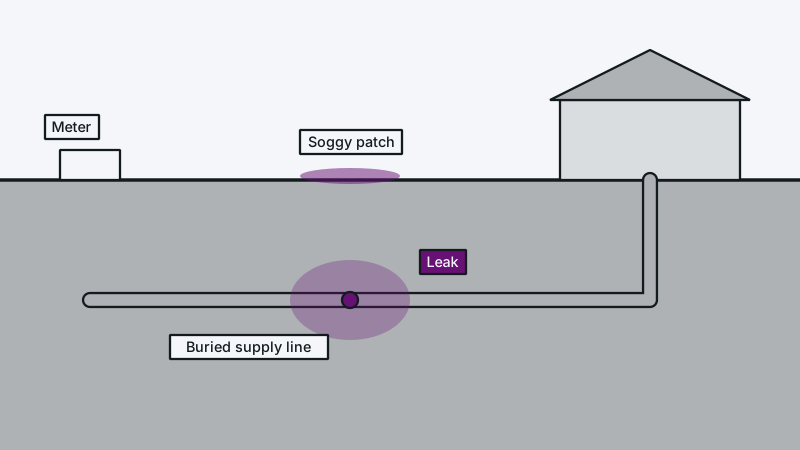
Underground water leak detection means finding where a buried supply line is losing water, usually between the street meter and your house, or along a line to a garage, guest house or pool. You start by proving the leak with a meter test, then a plumber pinpoints it with listening gear, a line locator or tracer gas. Digging comes last. This guide belongs to our wider set on leaks and burst pipes and covers the outdoor side only.
What are the signs of a leak under your yard or driveway?
Look for a soggy or sunken spot that stays damp through dry weather, an oddly green strip of lawn, pooling along a driveway edge, a meter turning while everything is off, and pressure dropping at the house. Often the first hint is a bill that climbs although use has not changed.
Southern California soil can hide a leak for a long time. Water finds the path of least resistance, so it may surface thirty feet from the break, or never surface at all if the soil drains well and the water travels down a slope or along a trench of loose backfill. A hillside lot can send it toward the neighbor's wall instead.
Listen at the meter box and at the hose bib nearest the house. A faint hiss with all fixtures closed is a good clue. Cracks in a driveway or pavers that settle in one line can mean washed-out soil underneath.
The EPA says the average family wastes about 9,400 gallons a year to household leaks, and a buried line with a steady leak can do far worse than a dripping faucet.
How do you check for an underground leak yourself?
Try the meter test. Switch off everything that uses water, record the meter reading and leak indicator, leave it for two hours or more and look again. A change means water is escaping. Then close the main valve at the house and watch the meter once more; if it keeps moving, the leak lies between the meter and the house.
The second step separates an outdoor leak from an indoor one. A meter that stops once the house valve is shut puts the leak past the valve, inside the house. A meter that runs on with the valve closed points at the buried line.
Rule out the common false alarms first:
- A running toilet (dye test: color in the tank, wait ten minutes).
- An irrigation timer that fired during the test window.
- A water softener or ice maker refilling.
- An evaporative cooler or pool auto-fill.
The EPA's Fix a Leak Week page describes the two-hour meter test and the toilet dye test. Our page on using the water meter to detect a leak shows how to read the dial and low-flow indicator.
How do plumbers locate a buried water line leak?
They combine a pressure test with sound. A ground microphone or listening rod picks up the noise of water escaping from a pressurized pipe, and a line locator traces where the pipe actually runs so the listening happens above it. For hard cases, a harmless tracer gas is pushed through the line and detected at the surface.
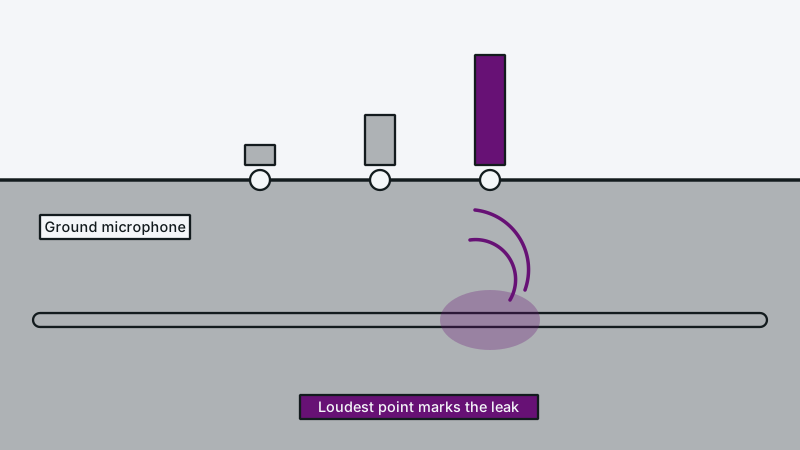
Here is what each tool does:
- Pipe locator. Traces the route of metal and plastic lines, often by putting a signal on the pipe. Old houses frequently have lines that no longer match the plan, so this is step one.
- Ground microphone. Pinpoints the loudest spot above the pipe. Concrete, deep burial and low pressure all make this harder.
- Tracer gas. Useful when sound is unreliable. The gas rises through the soil above the break.
- Pressure test. Confirms which section is leaking by isolating it.
- Pipe camera. Mostly for drain lines, not pressurized supply lines.
You may also see leak detection by cable and pipe locators described as CPL or cable-pipe tracing. It is a locating step, not a repair. Detection is typically the cheaper part. Fixr's published guide puts slab and underground leak detection at about $100 to $400, depending on how involved the search is, and that figure is a national guide only.
Before anyone digs, call DigAlert at 811. The call is free, per DigAlert, and marks gas, electric and other buried utilities so a shovel does not hit them. That matters in the Valley, where gas service lines and buried power run close to water lines.
Who is responsible for a leak on the line to your house?
In most places the utility owns the main and the meter, and the property owner owns the pipe from the meter to the house. Confirm the exact boundary with your utility before you hire anyone. In Burbank that is Burbank Water and Power, and Glendale, LADWP and other Valley providers have their own rules.
If the leak is upstream of the meter, call the utility. If it is downstream, it is yours to arrange. Burbank Water and Power lists (818) 238-3700 for weekday customer service and (818) 238-3778 for after hours, weekends and holidays, so you can ask which side of the meter a suspected leak sits on.
Your utility's advanced metering, where installed, can show round-the-clock usage. Flow that stays flat and constant overnight strongly suggests a leak rather than ordinary use.
Insurance often treats a buried line differently from plumbing inside the house, and many policies exclude or limit it. Ask your insurer before you decide on a repair.
What happens after the leak is found?
The plumber chooses between a spot repair in a trench, replacing the damaged run, or abandoning the old line and laying a new one. A short, accessible break in a trench is the simple case. A line that has leaked more than once, or that is galvanized steel from the 1950s, is usually better replaced than patched.
Trenching through a lawn is the least costly route. Under a driveway, patio or pool deck, a plumber may recommend boring a new line around the obstacle instead of breaking concrete. Each option has a different cost and a different mess, so ask for the alternatives in writing.
Permits depend on the work and the city. Burbank handles them through its building division, and LADBS handles the Los Angeles city neighborhoods. A replacement of a long run, or work that touches the main shutoff, is the sort of job where you ask first.
Do not dig for the leak yourself before the line has been located. Check the route and the depth first.
When should you call a plumber?
Make the call once a meter test shows movement with the house valve closed. You can handle everything up to that point. Beyond it, the locating, trenching, tying into the main and any work near gas or electric lines go to a plumber with a California contractor license, which the state's license lookup will confirm.
A local plumber we arrange will visit. Put the meter result, any wet spots and the age of the house on the quote form, and the written price follows the visit. If the leak also threatens a slab or foundation, slab leak detection covers the indoor version, and our cost guide for slab leak repair gives ranges for the more serious jobs.
Questions people ask
How long does underground water leak detection take?
Expect a few hours for a typical residential lot. The meter test and pressure test come first, then walking the suspected line with a locator and microphone. A shallow line in soft soil goes faster than a deep one under concrete. Digging and repair are separate visits, and the plumber will give you a schedule once the spot is marked.
What should I ask before I hire someone for underground water leak detection?
Ask what equipment they use beyond a meter check, what you receive in writing, and whether the detection fee is applied to the repair. Ask whether they call 811 before digging. Request their contractor license number and check it through the state. Also learn what happens if the leak stays hidden.
Do I need to be home for underground water leak detection?
Be present at the start to show the meter, the main valve and wherever you have seen water. Gates and dogs need handling too. If you cannot be home, arrange a neighbor or property manager, and ask the plumber to call you with the finding before anything is dug or cut.
Can a leak underground raise my water bill without showing on the surface?
Yes. Many buried leaks never show, particularly in well-draining soil or on a slope. The bill and the meter may be the only evidence. Before paying for a search, rule out other causes using why a water bill runs high.
This guide is one of many on plumber in Burbank.
References
Updated