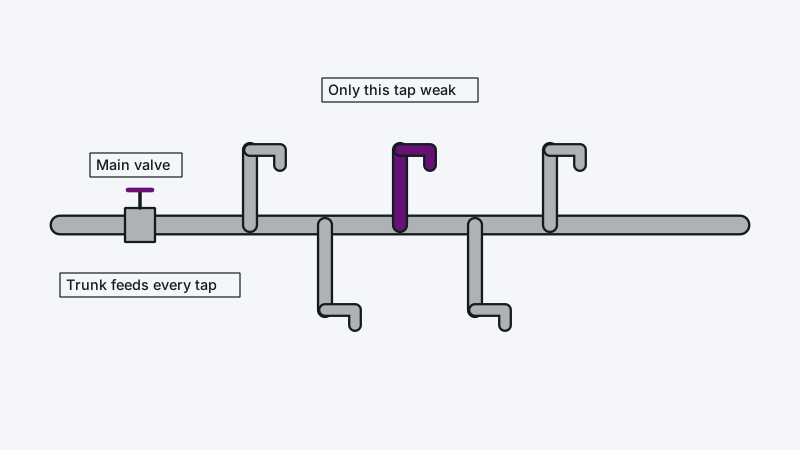
Low water pressure almost always has a findable cause. In a Burbank house the usual suspects are a main shut-off valve left partly shut, a worn pressure reducing valve, mineral scale or rust narrowing the pipes, a leak along the run from meter to fixtures, or work on the utility side. This page belongs to our water pressure and valves guide, and it takes you through the checks in the sequence a plumber would use.
Why is my water pressure low?
Pressure falls when something restricts flow, when water escapes before the tap, or when the supply at your meter is weaker than usual. Where it shows up tells you which. A lone slow faucet means a clogged part at that fixture. Weakness everywhere at once means the valves, the pipes or the supply.
Think of it as three zones. The street side belongs to the utility. The stretch from the meter to the house is your service line, and it includes your shut-off valves and the pressure reducing valve if you have one. Inside the walls are the supply lines and the fixtures. Pressure problems live in one of those zones, and a few minutes of checking usually narrows it to one.
Is it the whole house or just one fixture?
Walk through the house and open each faucet and shower. When a single fixture is weak, the trouble is local, most often a clogged aerator or showerhead, a half-closed stop valve below the sink, or a cartridge choked with debris. Weak hot water with strong cold points to the water heater and its connections. If everything is weak, read on.
Take the aerator off the weak faucet and check for gray grit or white flakes. Mineral flakes mean hard water is leaving deposits. Soak the part in a mild acid solution, rinse it and refit it. Which cleaners suit which finishes is covered in our hard water scale removal guide.
Also check whether the problem is timed. Pressure that sags every evening or on hot afternoons often reflects demand on the street, not your pipes. Pressure that fell suddenly after plumbing or landscape work points to a valve that was left partly closed.
Could a main valve or the pressure reducing valve be the cause?
Yes, and these are the cheapest to check. A main shut-off that is only partly open will throttle the whole house, and a pressure reducing valve (also called a pressure regulator) that has worn out or been set too low will do the same. Check the valves before you suspect the pipes.
Locate the shut-off at the meter and the one at the point the line goes into the house. Gate valves with a round wheel handle are easy to leave half open after a repair. Turn the wheel fully open, then back off a quarter turn. A lever-type ball valve should lie parallel to the pipe when open.
A pressure reducing valve looks like a brass bell on the main line, often near the water heater or the front hose bib. It exists to throttle high street pressure down to something your fixtures can handle, which is the job a pressure regulator does in any plumbing system. Over time the internal diaphragm and strainer wear, and the valve can creep low or stick. Some can be adjusted with a screw and locknut, but if the pressure keeps changing the valve is done. Replacing it is a plumber's job, and we can set up a visit to fit a new one.
Can old pipes in a Valley home reduce water pressure?
They can. Many Burbank and San Fernando Valley houses date from the 1940s through the 1960s, and some still carry galvanized steel supply lines. Galvanized pipe corrodes inward, and the buildup narrows the bore until flow drops. Old copper can also load up with scale where water is hard.
Galvanized steel is the classic case. Reference sources describe the interior of galvanized pipe corroding and building up layers that eventually cause pressure problems and failure. Symptoms include brown water once the line has stood unused, pressure that is worse on the hot side, and pressure that gets worse over the years, not suddenly.
Hard water adds to it. When water is heated, dissolved calcium comes out as scale, so water heaters, hot lines and tempered fixtures are hit first. The USGS classes water above 180 mg/L as calcium carbonate as very hard, and notes that scale can narrow pipes and reduce flow and pressure. Ask Burbank Water and Power for its latest water quality report to see how your supply reads, since we have not quoted a local figure here.
When the supply lines themselves are the cause, cleaning is only a stopgap. Replacement is the fix, and the whole-house repipe page explains how that job is quoted and done.
How do I measure my water pressure with a gauge?
Buy a hose-bib pressure gauge, thread it onto an outdoor spigot, turn off everything that uses water inside, and open the spigot fully. The needle shows static pressure in pounds per square inch (psi). Many plumbers treat the 40 to 60 psi band as comfortable for a house, and pressure well above that is usually reduced by a regulator.
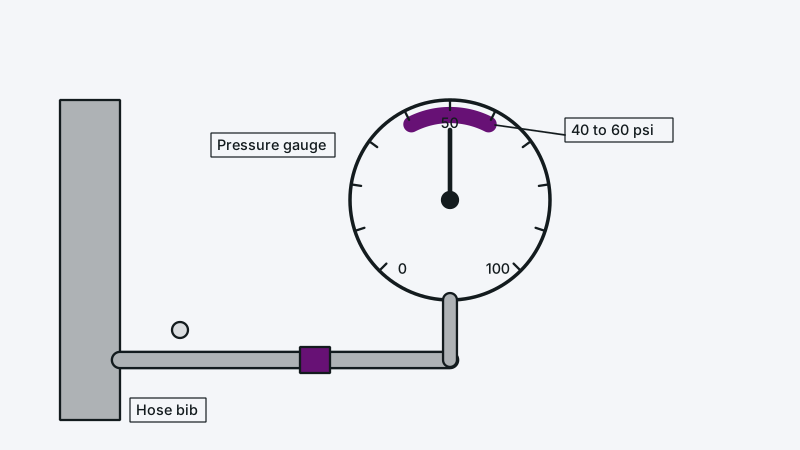
Do it twice, once mid-morning and once in the evening, so you can see whether the supply changes with demand. A reading that is low at both times means a restriction or a regulator problem. A reading that is fine on the gauge but poor at the faucets means the restriction is between the hose bib and the fixture.
Write the numbers down. They are the most useful thing you can hand a plumber, because they separate a supply problem from a pipe problem before anyone opens a wall. Gauges cost little at any hardware store, and most come with a drag needle that records the peak, which is handy for spotting spikes overnight.
Is low water pressure dangerous?
Low pressure is rarely a direct safety hazard, but it can point to one, and it makes some appliances work badly. A drop in pressure can mean a leak that is damaging your slab or walls. It can also cause shower temperature swings, and it can stop some water heaters and tankless units from firing properly.
A hidden leak is the thing to rule out first. If pressure fell and your water bill rose, read the meter with every fixture off. A dial that still turns means water is escaping. Our pages on finding a hidden leak and on a high water bill with no visible leak show what to do next.
Sudden loss of pressure with a wet patch, a hissing sound or a damp slab is a plumber call now: shut the main valve first. A gas smell anywhere in the house means getting out and ringing SoCalGas (1-800-427-2200) from the yard, or 911 if there is any danger. It is unrelated to water pressure, yet never assume.
A weak hot side can leave a shower stuck between too hot and too cold when someone flushes a toilet. Pressure-balancing valves help, though they are a plumbing job in their own right.
When should I call a plumber, and what will it involve?
Call when the gauge reads low at the hose bib, when the valves are open and nothing changed, when the pipes are galvanized, or when you suspect a leak. A local plumber visits, finds the cause and hands over a written quote ahead of any work. Utility-side trouble goes to the utility instead.
If neighbors have the same problem, call Burbank Water and Power: the main line is (818) 238-3700 on weekdays, and (818) 238-3778 after hours, weekends and holidays. In the LA city neighborhoods of the Valley the utility is LADWP, so call them there.
Otherwise, request a quote on our quote page. Include the gauge reading, which fixtures are weak, how old the house is and whether the pipes are galvanized, copper or plastic. A visit gets arranged, and the plumber tests pressure at the meter side and inside before quoting. Some fixes are small, like a valve or a regulator, and some are bigger, like a section of line. The quote reaches you before work begins.
If you would rather boost pressure than fix the cause, there is a separate page on adding a booster pump. Pumps suit a few situations, such as a hillside house above the main, and they do not cure leaks or corroded pipe. For a wider look at the topic, see Lankershim Plumbing or the water pressure and valves hub.
Questions people ask
What drops water pressure across the whole house?
With every fixture weak, look upstream of all of them: a half-shut main or meter valve, a pressure reducing valve on its way out, a restricted or corroded service line, a leak, or low supply from the street. Check valves first, then measure with a gauge at an outdoor spigot to see whether the problem is inside or outside.
Why is only the shower weak?
One weak shower normally means a clogged head, a worn cartridge, or a flow restrictor behind the head. Unscrew the head and check for scale. If the head is clean and only hot water is weak, the shower valve or a clogged hot line may be at fault, which is a plumber visit.
Is the water heater behind weak hot pressure?
Yes. Scale and sediment collect in the tank and in the hot outlet pipe, and a partly closed valve on the heater will throttle flow. If cold pressure is normal and hot is weak, the heater and its connections are the first place to look.
Will a pressure booster pump fix low pressure?
Only if the cause is low supply. A pump will not clear a clogged pipe or stop a leak, and it can push more water out of a hidden leak. Find the cause first, then decide whether a pump belongs in the plan.
How long is a low-pressure service call?
A diagnostic visit is usually short because the checks are quick: valves, a gauge reading and a look at the regulator. Replacing a regulator or a valve is a shorter job than replacing supply lines. Expect a likely time once the cause is clear.
What do I ask a plumber about pressure repairs?
Find out what they measure first, whether the quote includes testing at the meter, whether permits come into it, and what follows if a different part is to blame. Get all of it in the written quote ahead of the work.
References
Updated