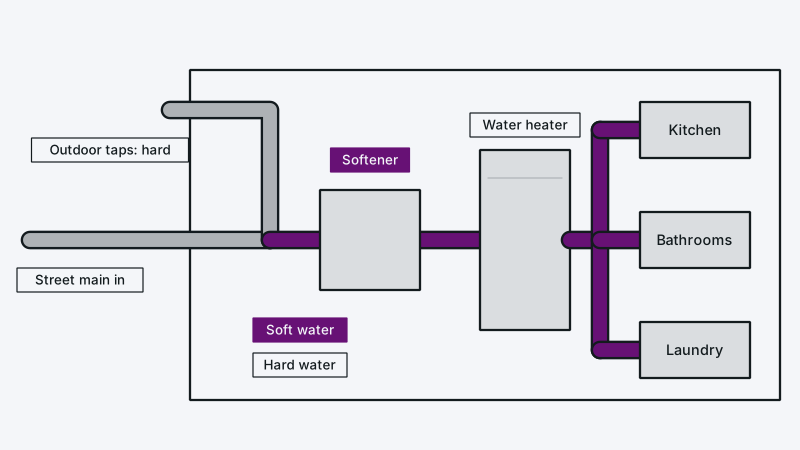
A whole-house softener is a single treatment unit installed on the main line, so every faucet, shower and appliance, along with the water heater, receives softened water. It is the opposite of a countertop or under-sink filter. The job has more to do with sizing and plumbing layout than with the brand on the tank. This page sits under our water softener installation guide and focuses on the whole-house decisions: capacity, flow, placement and what the install touches.
What does whole-house water softener installation mean?
It means the softener is cut into the main supply line at the point it comes into the house, ahead of the water heater and the branches to bathrooms, kitchen and laundry. Everything downstream gets softened water, apart from any lines the plumber leaves untreated, usually outdoor spigots and irrigation. The work includes a bypass, a drain connection and power for the control head.
A whole-house system differs from point-of-use treatment in one clear way: it protects the hot side. Scale from hard water builds fastest where water is heated, so a unit that softens ahead of the water heater helps the heater and the pipes beyond it. A filter under the kitchen sink protects only that tap.
The same job is sold under different phrases, such as whole-house system installation or softener installation service. They describe one thing: a plumber fits the unit to your main and gets it running. What varies is the size of the unit and what the plumbing around it looks like.
How big does a whole-house softener need to be?
Capacity depends on how hard the water is and how much your household uses. Installers often multiply daily use per person by the number of people and by your hardness in grains per gallon to get the grains the unit must remove each day, then pick a size that regenerates about once a week. Ask the installer to show the numbers.

Use this as a method, not a price list. Hardness comes from your utility report. Burbank Water and Power publishes one, and the figure changes with the supply, so read the current report. The USGS puts very hard water above 180 mg/L, and one grain per gallon is about 17.1 mg/L, so you can convert between a report in milligrams per liter and a sales sheet in grains.
A larger household, more bathrooms or a pool filling from the house line pushes the size up. A bigger tank regenerates less often, which uses less salt per gallon treated. An undersized unit regenerates constantly and wears out sooner. An oversized one costs more up front and can sit with stale water if little is used. Ask for the reasoning in the quote.
Does a softener lower water pressure or flow?
Any treatment unit adds some restriction, because water has to pass through the resin bed and the control valve. A properly sized unit with a decent flow rating causes only a small pressure drop. An undersized one, or one with a small valve on a big household, can make showers weaker and appliances slower to fill.
Check the flow rating in gallons per minute, not just the grain capacity. Add up what could run at the same time: two showers, a washing machine and a dishwasher. If the unit's rated flow is below that, you will feel it.
If pressure was already marginal, check our page on why water pressure is low first. Low pressure is not something a softener repairs, and it can make a weak supply feel worse. Galvanized pipe common in 1940s to 1960s houses complicates it further, since old pipe may already be narrowed.
What does the plumber do on the day?
Expect the water to be off during part of the visit. The plumber checks the main and its material, picks the location, drains the line, cuts in the unit with a bypass, runs the drain with an air gap, connects power, fills the brine tank, sets the hardness and starts a regeneration. Then the water is back on and they check for leaks.
The order matters. Before cutting anything, the plumber finds the main shut-off and tests that it closes. A shut-off valve that fails to close fully is a common surprise in older houses and can turn a one-afternoon job into a valve replacement first. If the house has a pressure reducing valve, the softener usually goes after it, and the plumber notes the reading.
At the end they should walk you through the bypass, show you where to add salt, explain the settings and tell you what to watch for in the first weeks. Soft water feels slick, and some people notice it right away. Soap use drops because soap lathers properly in soft water.
Which parts of the house should stay on hard water?
Most installs leave outdoor hose bibs and the irrigation line on untreated water, since lawns and car washing gain nothing from soft water, and it saves salt. Some owners also keep one kitchen cold tap on hard water for drinking, because ion exchange adds sodium to softened water.
A plumber can split the line with a tee before the softener to feed those branches. That adds a few fittings and some labor, and it belongs in the quote line by line. Ask for it if you want it, because fixing it later means cutting the line again.
On sodium: the Wikipedia article on water softening cites a study with softened water averaging 278 mg/L sodium, and notes the EPA considers sodium in drinking water unlikely to cause adverse effects. If you are on a low-sodium diet, ask your doctor. The kitchen bypass is the practical answer.
Are there permits or local rules in Burbank?
Some cities require a plumbing permit to connect a treatment device to the water supply, and some California communities restrict salt-based softeners because of brine discharge to the sewer. We have not verified a specific Burbank requirement, so confirm with the Burbank Building Division and your sewer agency before work starts.
Get it in writing. A good quote says who pulls any permit and what follows if an inspection is called for. A house in an LA city neighborhood such as Van Nuys or Sherman Oaks answers to LADBS, not Burbank. Our neighborhoods page lists the areas we cover.
If the unit goes in a garage with a gas water heater nearby, the plumber should keep clearances from the heater and its vent. Do not stack boxes of salt against it.
Salt-based or something else?
A salt-based ion-exchange unit is the proven way to remove hardness. Salt-free conditioners change how scale forms without removing minerals, and results vary. If you want the detail on the ion-exchange type, read salt-based water softener installation. For visit costs and quote reading, see the price guide.
Some readers will prefer doing it themselves, and the DIY softener page sets out which steps a handy owner can manage and which should go to a plumber. Before buying, learn what scale already does in your house: removing hard water scale shows how bad it is.
When should I call a plumber?
Make the call if the main is old steel, the shut-off valve is stiff, you want outdoor taps split off, or the drain and permit rules are unclear. A local plumber visits, measures the setup and hands you a written quote ahead of any work.
Request a quote on the quote page and include the house age, number of people, number of bathrooms, the pipe material, and the hardness figure from your utility report. We'll arrange a visit. Lankershim Plumbing lists the other jobs we line up around Burbank and the Valley.
Questions people ask
How long is a whole-house softener install?
A typical install on an accessible main takes a plumber a few hours, including shutting off and draining the line, fitting the bypass, running the drain and setting the controls. Old galvanized pipe, a stiff shut-off valve or a long drain run adds time. An estimate belongs in the written quote.
Will I need to turn off my water?
Yes, for part of the visit. The main has to be closed before the line is cut, and you will be told ahead of time about how long the supply stays off. Fill a few containers beforehand if you want water for drinking or flushing while it is off.
Can a whole-house softener work with a tankless water heater?
Often yes, and softening helps tankless units because scale on the heat exchanger is a common failure. Check the heater maker's water quality requirements and the softener's flow rating, since tankless units can demand a high flow. Ask the plumber to confirm the two are compatible before the quote.
What should I ask a plumber about a whole-house softener?
Ask how they sized the unit, what flow rate it is rated for, whether outdoor lines will bypass it, where the drain goes, if a permit applies, and what the quote covers should the pipe or shut-off valve need work. Have the answers written down.
Must someone be home during softener installation?
Have someone present at the start to point out the main shut-off and okay the unit location, and again at the end for the walkthrough. Between those, the garage or utility area and the drain must stay reachable. Settle the plan when you book.
References
Updated