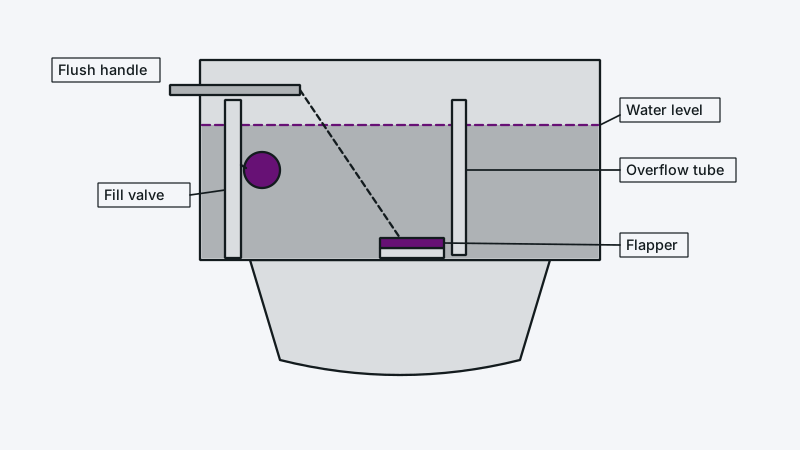
Three parts cause nearly every running toilet: the flapper sitting low in the tank, the fill valve that refills it, or a float adjusted too high. Pop the lid, check the overflow tube, then run the dye test. Parts usually run a few dollars and the work finishes inside 30 minutes. This page sits under our toilet repair guide, which links the detailed pages for each part.
How do you tell what is making the toilet run?
Lift the lid and watch the water. Water pouring into the overflow tube means the float sits too far up, or the valve will not close. If the level looks normal but the tank keeps topping up, stir several drops of food coloring into the tank and give it ten minutes. If the bowl water changes color, the flapper leaks.
Go through the list below and stop once something explains the problem.
- Listen. A steady hiss with a full tank suggests the fill valve. A trickle that starts again every few minutes suggests the flapper.
- Look at the overflow tube. If water runs down the inside of it, the level is above its rim.
- Press the flapper down. If the noise stops when you hold it against the seat, it is not sealing on its own.
- Check the chain. Too tight and it props the flapper open. Snagged beneath the flapper and it blocks the seat.
- Do the dye test. Give it ten minutes, then look in the bowl. Flush right away so the tank is not stained by the dye.
The EPA reports that worn flappers are a frequent source of silent toilet leaks, and that nine percent of homes leak 50 gallons or more every day. A few minutes of checking is worth it.
How do you fix a toilet that runs because of the chain or handle?
Start with the chain inside the tank. With the flapper shut, it should hang with roughly half an inch of play. Too tight, add a link. Tangled, cut off the excess. A handle that sticks or a lever arm rubbing the tank wall can be bent clear, or the whole handle swapped.
A handle stuck in the down position often keeps a toilet running after the flush. The plastic nut that holds it to the tank usually has a reverse thread, so you tighten it by turning it the "wrong" way. A cracked handle or bent arm is cheap to replace. Our page on fixing a flush button or handle goes deeper, with and without a chain.
How do you fix a flapper that will not seal?
Wipe both the flapper and the seat it rests on, then test again. A soft, curled, cracked or slimy flapper should be replaced with a matching one for the flush valve opening, usually 2 or 3 inches. Close the supply, unhook the old flapper, attach the new one, leave the chain a touch loose and flush to test.
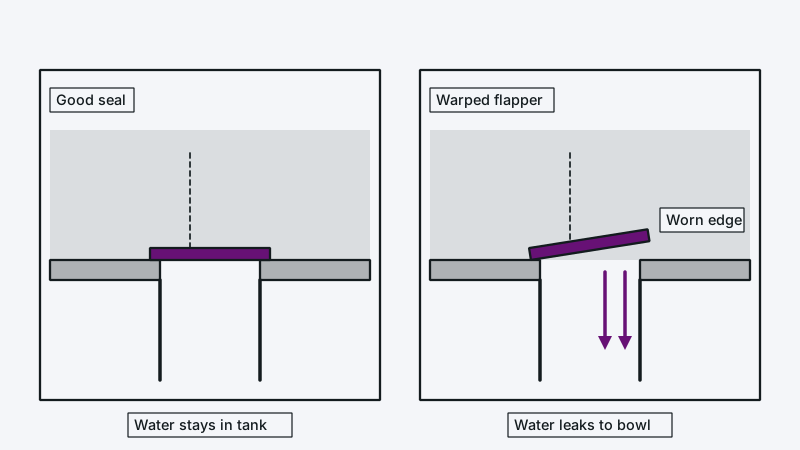
Rubber breaks down fast in warm bathrooms, and the EPA recommends a new flapper at least every five years. Our toilet flapper repair guide gives the full walkthrough, including the case where a fresh flapper still leaks because the seat is rough.
How do you fix a fill valve that will not shut off?
Try lowering the level first, using the adjustment screw or by sliding the float down one notch, until the water stops roughly one inch under the rim of the overflow tube. If it still never stops, the valve is worn out or clogged and needs replacing.
The swap is quick: close the shutoff, empty the tank, take off the supply line, loosen the locknut beneath the tank, fit the new valve and set its height. One repair guide puts working time at 15 to 30 minutes and parts at about $10 to $20 for a typical running toilet, with the whole job taking up to an hour. Each step is spelled out in the fill valve repair walkthrough.
Why is the toilet leaking onto the floor as well?
A puddle on the floor is a separate fault, although both can show up together. Leaks from the base, the tank bolts or the supply line each need their own repair. Dry everything, wrap dry toilet paper around each joint, flush, and see which piece turns wet.
When the base is leaking, the wax ring has most likely failed and needs replacing; caulk will not fix it. Leaking toilet repair maps the leak types and who should deal with each. If the wetness is at the wall shutoff, see toilet shutoff valve repair: many Burbank homes built between the 1940s and 1960s have stiff old valves that a plumber may need to replace.
What does a running toilet cost you?
A toilet that runs can inflate your water bill, and nothing visible gives it away. A slow leak into the bowl goes all day and all night. The EPA estimates that the average family loses about 9,400 gallons a year to household leaks, though your own figure depends on how big the leak is.
The dollar amount depends on your utility's rates. Burbank Water and Power, Glendale Water and Power and LADWP each set their own, so find the price per unit on your statement. To test for a leak, read the meter, shut every tap and appliance, and read it again after 15 minutes. Any movement means water is escaping. That test is explained in why a water bill is so high.
How do you install a new toilet if repairs do not work?
Close the water, empty the tank and bowl, remove the supply line and the closet bolt nuts, then lift the old toilet off and scrape away the old wax. Press a new wax ring onto the flange, lower the new toilet straight down, tighten both nuts evenly, reconnect the water and check for leaks.
Plan on two people to lift it. Older Valley homes sometimes have a cracked flange, or one sitting below the floor, and fixing that is a plumber's job. If you are weighing replacement against repair, look at toilet replacement cost first, because both labor and toilet prices vary widely.
When should you call a plumber?
Bring in a plumber when the shutoff valve will not close all the way, the tank is cracked, parts are corroded, or the toilet keeps running after a new flapper and fill valve. Those problems need different parts and tools, and a toilet left running adds to your bill every day.
This is an easy job to price. A local plumber can come to homes across Burbank, Glendale, North Hollywood and the nearby Valley, and the price is set in writing before work begins. Ask for a quote and describe what you have tried already, so the plumber shows up carrying the correct parts. Everything else we handle is listed on the Lankershim Plumbing home page.
Questions people ask
Why does my toilet run for a few seconds every few minutes?
This is ghost flushing. Water seeps out of the tank into the bowl, normally past a worn flapper, so the level sinks and the fill valve refills it. Swap the flapper and clean its seat. If the cycle continues, the flush valve seat itself is damaged.
Is a running toilet bad for my plumbing?
The pipes are fine, but the water is wasted, your bill climbs, and a part that is close to failing can go unnoticed. The constant refilling also ages the valve faster. Repairing it now costs less than waiting.
How much does it cost to fix a running toilet?
Parts run a few dollars, and one guide to the repair puts them at about $10 to $20. With a plumber, you mostly pay for the visit: rates are roughly $45 to $200 per hour, sometimes with a service call fee on top. Get the quote in writing.
Can I fix a running toilet without turning off the water?
Adjusting the float and chain is fine with the water on, but shut it off before replacing any part. The tank must be empty to reach the flapper or fill valve, and the supply line must come loose to change the valve. Reopen the shutoff slowly afterward.
What if my toilet only runs at night?
The house is just quieter at night, so you hear it. The cause is unchanged: a flapper or fill valve that does not seal. Run the dye test before bed and inspect the chain. A flapper that sticks on a rough seat can make the problem come and go.
References
Updated