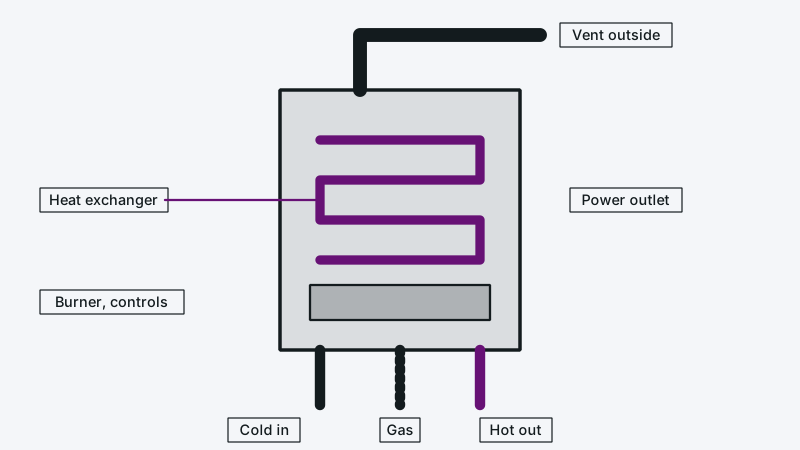
Published guides put tankless water heater installation at about $1,333 to $3,721, with a national average near $2,527. Switching from a tank to tankless brings new venting and often a bigger gas line, which can push labor alone toward $2,500. Swapping one tankless unit for another costs less. Tank models are covered in our water heater repair guide.
How much does a tankless water heater replacement cost?
A typical installed range is about $1,333 to $3,721, averaging $2,527, according to a published guide that draws on Angi and HomeAdvisor figures. The unit itself commonly costs $800 to $1,500 whether gas or electric. Labor often totals $600 to $1,850, but only a local quote gives your true figure.
The line items from the same source:
| Item | Typical range |
|---|---|
| Electric tankless unit | $800 to $1,500 |
| Natural gas tankless unit | $1,000 to $1,500 |
| Labor | $600 to $1,850 |
| Removing the old heater | $500 or more |
| Permit | $50 to $100 |
| New gas line, if needed | up to $1,000 |
| Hard-to-reach location | 10 to 15 percent more |
A second guide prices a tank-to-tankless conversion at up to $2,500 in labor, as the venting, gas and sometimes electrical work all change. Another says Los Angeles replacement costs run higher than in cheaper markets, though that figure is for tanks. Ask for a number that fits your exact house.
Why does a tankless water heater cost more to install than a tank?
Because the house usually has to change to fit it. A tankless gas unit needs an outside vent, often a bigger gas line to feed its higher burner rate, and a power outlet for its controls. A tank sits where the old tank sat. A tankless unit rarely drops in without piping, venting or gas modifications.
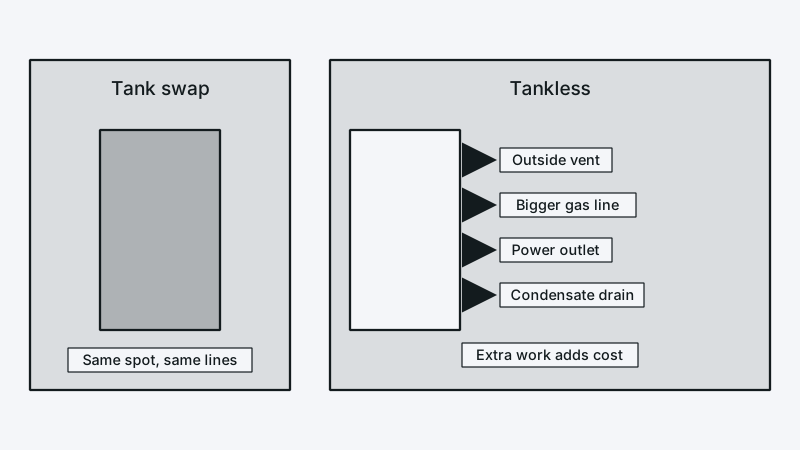
Wikipedia notes gas tankless units need an exhaust vent or pipes at the top and still need electricity for the electronics and ignition, and that installers may need to upsize the gas pipeline and replace the existing vent pipe. Pressure and volume of gas both have to meet the unit's requirement.
The usual extra work:
- Venting. All gas tankless units must vent outside, by power vent or direct vent.
- Gas line. A tankless burner draws far more gas at once than a tank burner, so the old line may be too small.
- Electrical. A nearby outlet, or a new circuit for electric units. Electricians run $50 to $100 per hour in the guide.
- Condensate drain. High-efficiency condensing units need a drain for acidic condensate.
- Water treatment. On hard water, a filter or softener may be recommended to protect the heat exchanger.
Plenty of postwar Valley homes still have a 1950s gas line that was sized for a tank heater and a furnace and nothing more. A plumber measures the load before quoting. A line that is too small shows up as its own entry on the estimate.
What affects the price of replacing one tankless unit with another?
If you already have a tankless heater, a like-for-like swap skips most of the extra work, since the vent, gas run and outlet already exist. The price is mostly the unit, labor and old-unit removal. Changing capacity or fuel, or finding an old vent that no longer meets code, changes the picture.
What can still raise the bill:
- A bigger unit. If you added bathrooms, you may want more flow, which means a larger burner and perhaps a larger gas line.
- Venting that is out of date. A plumber may need to replace the flue for the new model.
- Isolation valves. Adding service valves makes future descaling cheaper and is a common request.
- Recirculation. Some homes add a recirculating pump to cut the wait for hot water.
- Brand and warranty. Models with longer parts warranties cost more.
Tankless water heaters are often said to last up to about 20 years, compared with 8 to 12 for a tank, so some of the premium is paid back in life span. They also need yearly descaling, particularly on hard water. If your current unit has been troubled by scale, read instant water heater repair before deciding whether to replace or fix.
What else is in a tankless water heater replacement quote?
Expect the unit, labor, venting, gas or electrical changes, a permit, earthquake strapping or wall mounting, the discharge pipe, removal of the old heater and a test run. Ask whether the permit, wall repair and any condensate line are in the price. A clear quote lists each, so you can compare two of them fairly.
State law has water heaters braced, anchored or strapped to resist earthquake movement, and new and replacement installs are included. A wall-hung tankless unit is mounted differently from a tank, so ask how it will be secured.
Gas and electrical work have legal limits. Gas piping belongs to a contractor who holds a California license, and cslb.ca.gov lets you check any plumber. If you notice a gas smell, go outside and then call SoCalGas at 1-800-427-2200.
Before you spend this money, compare the options. Our tankless vs tank page sets out the trade-offs, the tankless installation price page covers a fresh install, and gas water heater replacement cost shows the tank side.
To get a price for your house, request a quote. A local plumber we arrange will come to the house and write up the price before work begins. Our other services are on the Lankershim Plumbing home page.
Questions people ask
How long does tankless water heater replacement take?
Replacing one tankless unit with another often takes half a day. Moving from a tank to tankless generally means a day or longer, since the plumber may run a new vent, upsize the gas line and mount the unit on the wall. Permits and inspections can add a few days before the work starts.
What should I ask before I hire someone for tankless water heater replacement?
Ask whether they have measured your gas line against the unit's requirement, and how the unit will be vented. Get a written quote that itemizes venting, gas, electrical and permit costs. Ask about the warranty on parts and labor, and check their California contractor license at cslb.ca.gov.
Do I need to be home for tankless water heater replacement?
Yes. An adult needs to be home to provide access, okay any changes and watch the test. Gas and water go off for a while. Because a tankless install can involve walls and an exterior vent, the plumber may need access inside and outside the house. Mention gates, pets and parking.
Is a tankless water heater worth the extra cost?
It can be, if you value endless hot water, a smaller footprint and a life span of up to about 20 years. The up-front cost is higher and it needs yearly descaling. If your gas line and venting would need heavy work, a high-efficiency tank may be better value. A plumber can price both for your home.
Can a tankless water heater run out of hot water?
Not in the way a tank does, but it has a flow limit. Run too many fixtures at once and the unit cannot heat all of the water, so the temperature drops. Many models also need a minimum flow to ignite. A plumber sizes the unit to your peak demand, which depends on the number of bathrooms.
References
Updated