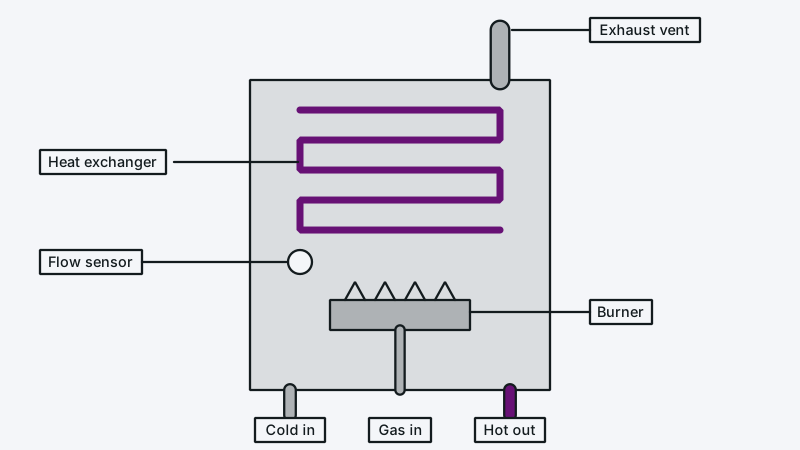
Instant water heater repair means fixing a tankless unit, one that heats water only when a tap is open. Mineral scale inside the heat exchanger, a gas or electrical supply fault, a blocked vent, or a water flow too weak to trigger the unit cause most failures. A plumber can usually sort these out in a single visit. See our wider water heater repair guide for tank models.
What counts as an instant water heater?
Instant heaters go by tankless or on-demand as well, and they hold no stored water. Cold water passes through a heat exchanger, where a gas flame or an electric coil warms it in transit. Some people also use the phrase for a small point-of-use unit under a sink, and the troubleshooting is similar.
Because nothing is stored, tankless water heaters never run out in the middle of a long shower, but they have limits a tank does not. Each model has a top flow rate, so running two showers and the dishwasher together can overwhelm it. Many also have a minimum flow, below which the burner will not fire. Wikipedia notes that this leaves a gap between cold water and the coolest warm water the unit can give, which is why a trickle at a basin often stays cold.
Even gas units rely on electricity for ignition and controls, so a power cut, tripped breaker or dead outlet stops them while the gas is fine. Each also needs an exhaust vent to the outside, and some installs call for a wider gas line than the old tank did.
Why is my tankless water heater not heating?
Usual causes: scale choking the heat exchanger, interrupted gas or power, a blocked vent or condensate drain, or flow under the unit's minimum. Most models flash a fault code on the screen, and the manual decodes it. Note the code before resetting, because the plumber will ask for it.
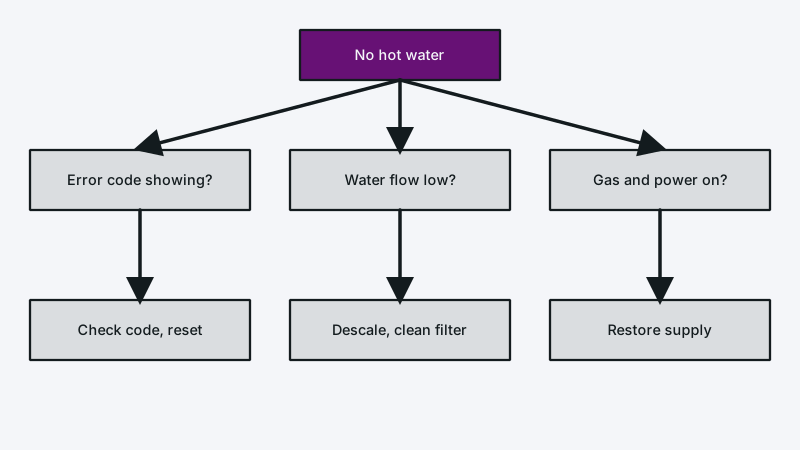
Go through these steps in order.
- Check power and gas. Is the display lit, the gas valve open and the breaker on? Other gas appliances working tells you the supply is fine.
- Check the flow. Open a tap fully. A clogged aerator or showerhead can drop the flow under the minimum and the heater will not start.
- Look for a code. Scale and overheating faults, ignition faults and vent faults each have their own.
- Think about scale. Wikipedia notes copper heat exchangers scale more than stainless steel, and that buildup can block small channels, cut efficiency and trigger overheating shutdowns. Manufacturers typically call for yearly descaling through the service valves.
- Do not open the gas side. Gas piping, the burner and the vent are plumber work.
Lukewarm water, a hot-cold-hot pattern, or a heater that shuts off after a few seconds all fit the scale and flow picture. Water in the Valley comes from different utilities, so hardness varies by neighborhood. Burbank Water and Power, Glendale Water and Power and LADWP each publish a water quality report, and it is worth reading yours.
What does an instant water heater repair involve?
The plumber starts with the fault code, then tests gas pressure, venting and power, and flushes the exchanger with descaler pumped through the service valves. Other fixes involve swapping a flow sensor, igniter, fan or control board. Parts and labor vary by make, and the quote should name the probable cause before work begins.
A descaling flush is the single most common job. The plumber isolates the unit, runs a pump and a mild acid solution, usually vinegar or a manufacturer cleaner, through it, then rinses. It is why many makers ask for it yearly. Skipping it on hard water is the reason many units are in trouble by year five or six.
Other jobs the plumber might do:
- Clean or replace the inlet water filter screen.
- Clear the exhaust vent or condensate line on high-efficiency units.
- Replace a failed sensor or board, where the manufacturer still sells it.
- Resize the gas line, which matters when the unit went onto a line that was borderline from day one.
Most tankless units are said to last up to about 20 years, against 8 to 12 for a tank, so a repair is often worth it on a newer unit. On an older one, ask what the board or exchanger costs against a new unit. Our guide on tankless water heater replacement cost gives the replacement side of that comparison.
Is an instant water heater repair better than replacing it?
Repair is usually better if the unit is under about 12 years old and the fault is scale, a sensor or a vent problem. Replace it when the heat exchanger has failed, parts are no longer made, or repairs keep returning. If you are weighing a switch from tank to tankless, compare both on our page for tankless vs tank water heaters.
If you have a tank heater and are reading this because you want something faster, remember that a tankless swap in a postwar Valley ranch house often brings a larger gas line, fresh venting and possibly a new electrical outlet. Those add to the price, and they are the reason a repair may be the cheaper path for now.
Ask any plumber three things before you decide:
- What is the exact fault, and how do they know?
- Is a flush enough, or is a part needed?
- Does the unit's warranty cover the repair?
When do I call a plumber and what should I do first?
Phone a plumber when the unit throws an ignition or vent error, cuts out by itself, leaks, or gives off a gas smell. For gas, get out of the house first, then dial SoCalGas at 1-800-427-2200 from the street, and use 911 for any emergency. Anything else, you can safely check the power, the gas valve position and the aerators.
A burner that will not light is not a reason to keep pressing reset. Repeated attempts can flood a chamber with unburned gas. Wait, air the room out, and call. The plumber we arrange will come to you, check the unit and write up a price before starting.
To book someone out, request a quote and give us the make, the fault code showing and the unit's age. There is more about how we work on the Lankershim Plumbing home page, and a related symptom is covered on why you may have no hot water.
Questions people ask
How long does instant water heater repair take?
Expect one to three hours on site for a descaling flush or a part swap. A control board or fan that must be ordered can bring a second trip, depending on the make. A plumber who knows the model will tell you after the first look whether the repair can be finished the same day or whether a part has to arrive first.
What should I ask before I hire someone for instant water heater repair?
Check that they service your brand and understand its fault codes. Get the probable cause and a written price up front, plus whether parts are under warranty and a descaling flush is part of the call. Confirm a California contractor license through the state board's lookup at cslb.ca.gov.
Do I need to be home for instant water heater repair?
Plan for an adult to be home, at least for the first and last few minutes. Access to the heater is needed, along with a temporary water and gas shutoff, and you will want to see it tested. If it is outside or in a locked garage, arrange access and tell them about gates and pets.
Why does my tankless water heater turn on and off?
Cycling tends to trace back to flow too weak to keep the burner lit, a scaled exchanger, or a bad sensor. Open the tap further and see if it steadies. Clean the showerhead and aerator. If it keeps cycling, the unit needs a plumber to check scale, gas pressure and the vent.
How often should a tankless water heater be flushed?
Manufacturers typically ask for a yearly descaling through the service valves, and Wikipedia notes they may also want water testing and treatment. Your model's manual matters here, since some warranties depend on it. In harder water areas, a plumber may suggest more often. A water softener or filter upstream can reduce the load.
References
Updated