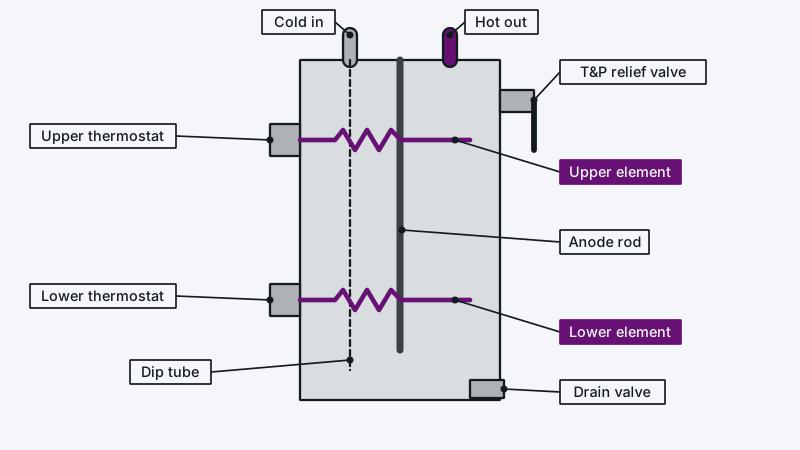
If an electric water heater gives no hot water, work through three checks in order: the breaker, the red reset button under the upper access cover, and whether the water coming off the tank runs hot or cold at a tap. A tripped breaker or reset is a one-minute fix. If it trips again, or the water stays cold, suspect a dead element or thermostat, and that repair is a plumber's job. Compare with gas models in our water heater repair guide.
Why does my electric water heater have no hot water?
Common culprits are a tripped breaker, a tripped high-limit cutout, a burned-out heating element or a faulty thermostat. Electric tanks usually have two elements, one near the top and one near the bottom, each with its own thermostat. When the upper one dies, you get almost nothing hot. When only the lower one dies, the hot water runs out fast.
Bob Vila's electric-heater checks start with a power surge (shut the unit off for a couple of minutes, then turn it back on) and a tripped breaker (flip it off, count to about 20 and flip it back on). A breaker that refuses to stay on may need a professional to replace it. The same guide says to power the unit down before you inspect or repair anything.
Here is how each symptom maps to a cause:
| Symptom | Probable culprit |
|---|---|
| Completely cold taps | Breaker, high-limit switch, upper element or thermostat |
| Hot water for a few minutes, then cold | Lower element or thermostat, or sediment |
| Lukewarm water | Lower element, thermostat set low, or a dip tube fault |
| Breaker trips again after reset | Shorted element or wiring fault |
Wikipedia notes that a typical 60-gallon electric tank has a 4.5 kW element, and that thermostats read the water at their own height, so lower water can be much cooler than the setting suggests.
What if the electric water heater has no power at all?
With a heater that has no electricity at all, look at its circuit breaker, any disconnect switch on the wall nearby, and whether other circuits in the house still have power. A tripped breaker or a switch left off explains most cases. If the breaker is on and the heater is still dead, the fault is in the wiring, and an electrician has to inspect it.
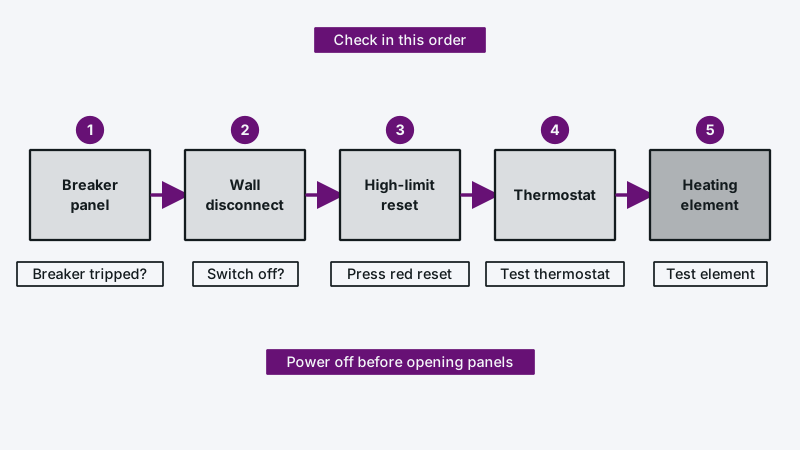
Take it step by step:
- Locate the heater's breaker, normally a double-pole type, two switches joined as one, with a label for the heater.
- Push it fully off, then back on. A tripped breaker rests in the middle position.
- Look for a disconnect switch mounted on the wall beside the heater.
- Stay away from the panel and the heater wiring if you notice scorch marks, a burning smell or a breaker that trips immediately.
Electric water heaters run on 240 volts, enough to kill. Never open the heater's access covers while it has power, and leave wire testing to someone trained. Circuit and breaker repairs belong to an electrician. A dead element is a heater fault, so a plumber swaps the part, and we can line up the right trade once you know what you found.
How do I know if the element or thermostat has failed?
The plumber cuts the power, removes the access covers and tests every element and thermostat with a meter. An element reading open, meaning no continuity, is dead. A thermostat that never switches is bad. A guide lists a heating element at about $200 to $300 and a thermostat at about $150 to $200 with installation.
The typical pattern: a dead upper element or thermostat means no hot water, and a dead lower element means only part of the tank heats. Elements coated in mineral scale burn out sooner, and hard water speeds that up. Check your own supply in the water quality report from Burbank Water and Power, Glendale Water and Power or LADWP.
Replacing parts makes sense on a heater younger than about 10 years. Tank heaters normally last 8 to 12 years. Once a tank is older and full of sediment and rust, spending on a new heater usually pays off better. Our page on thermostat replacement for an electric water heater goes into that part, and electric heater replacement cost covers a swap.
Can a broken water heater cause a high electric bill?
Yes. A thermostat stuck on keeps the element heating, a scale-coated element takes longer to do its job, and a leak from a hot pipe or the tank makes the heater warm fresh water again and again. An aging unit burns more power for the same output. If your bill jumps and your habits have not changed, get it looked at.
Signs to look for:
- Hot water that is too hot, which can mean a stuck thermostat. Take care, because Wikipedia notes water at 140 degrees F can burn skin in under five seconds.
- A tank that never rests, with a warm humming sound, or a heater that never seems to cycle off.
- A slow leak, such as a dripping relief valve or hot pipe, since replacement water has to be heated again.
- An old unit with heavy sediment on the elements.
A plumber can test the thermostat settings, scale buildup and leaks, then weigh a repair against a new unit. Your electric utility can show your usage history if you want to see when the bill rose. Burbank Water and Power, Glendale Water and Power and LADWP are the electric utilities for most of this area.
Who should I call for no hot water from an electric heater?
Phone a plumber when the breaker holds but the water stays cold, because an element or thermostat is probably to blame. Phone an electrician when the breaker keeps tripping, you spot scorching, or the circuit is dead. Water leaking from the tank itself means a new heater is due. Do not try panel or wiring work on your own.
Want someone out? Use the quote form and we will send a local plumber to your address, and you will have the price on paper before the job begins. For a heater that has had its day, see how often a water heater should be replaced and the Lankershim Plumbing home page for everything else we handle, including tankless water heaters and water heater replacement.
Questions people ask
How long is the repair when an electric heater gives no hot water?
Swapping an element or thermostat runs roughly one to two hours of plumber time, then the tank needs an hour or more to reheat. A breaker or wiring fix by an electrician is usually quick. If the tank has failed, replacement takes a half day. Many homes have hot water again by evening.
What do I check with a contractor before booking an electric heater fix?
Have them test the elements and thermostats before swapping anything. Get a written price covering parts and labor, find out whether the circuit needs an electrician, and ask about any warranty on the work. Verify their California contractor license at cslb.ca.gov, and ask if they favor repair or replacement at the heater's age.
Must someone be home during an electric heater repair?
Yes. An adult should be on hand so the plumber can reach the heater and the electrical panel, and to okay any added work. The heater stays unpowered during the repair. When it sits in a garage, closet or attic, move stored items out of the way first.
What makes an electric heater keep tripping its breaker?
If the breaker trips again after a reset, the cause is usually a shorted element, a wet or damaged wire, or a bad thermostat. Stop resetting it. Leave the power off and call a plumber or an electrician, because shock or fire is possible. A fresh element or thermostat often cures it.
Why is the water hot for only a few minutes?
Hot water that runs out quickly usually points to a dead lower element or its thermostat, which leaves just the top of the tank heated. Sediment can also crowd the tank, and a broken dip tube can send cold water into the hot. A plumber tests each one. A tank past 10 years may be worth replacing instead.
If the tank is not heating at all, see what to check when a water heater is not heating.
References
Updated