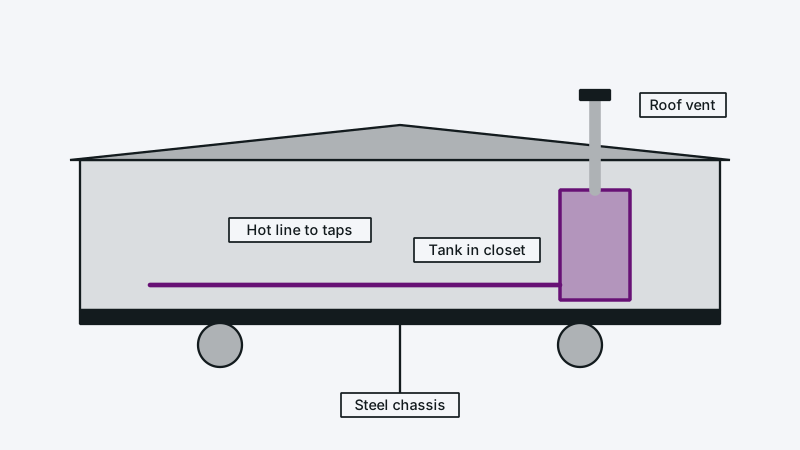
A mobile home water heater replacement usually runs from about $1,200 to $3,000 installed for a standard tank, as a rough guide. The unit is often a model made for manufactured homes, and the closet is small, so labor and parts can push it higher than a house job. A written quote after a look at your closet gives the real figure. This page explains what moves the price. For broader context, begin with water heater repair and replacement.
Why does a mobile home water heater cost more than one in a house?
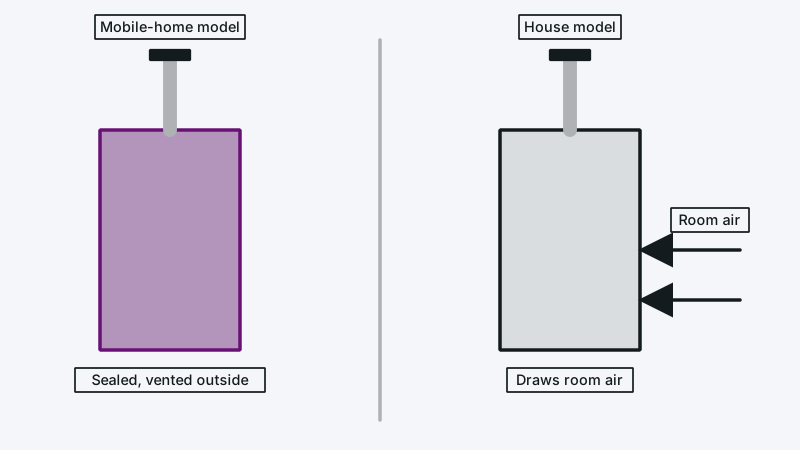
A federal code governs how manufactured homes are built, and the water heater must be a model its maker approves for that type of home. Gas versions are normally sealed or vented straight outside, because there is no basement or garage for combustion air. Those models are less common on shelves, so the part itself can cost more than a plain tank.
Then there is the space. Many of these homes have a closet only a little wider than the heater, with a door panel or a floor hatch. A plumber may need to drain the old tank, wrestle it out through a small opening and fit the new one against the wall without room to turn a wrench. Extra time on site is the quiet part of the bill.
Water lines are another factor. Older mobile homes often have plastic supply lines with push fittings or small flexible connectors. A plumber who finds brittle fittings behind the old tank will tell you before cutting. Replacing them adds a modest amount and avoids a leak in six months.
What does it cost to replace a water heater in a mobile home?
Think of it in three parts: the unit, the labor and the extras. Prices below are a guide for the Burbank and San Fernando Valley area, not a quote, and your closet, your fuel and the state of the old plumbing set the real number.
| Part of the job | Typical range, as a guide |
|---|---|
| Electric tank, 30 to 40 gallons, sized for a manufactured home | $1,000 to $2,200 installed |
| Gas tank approved for a manufactured home | $1,500 to $3,000 installed |
| Small tankless or point-of-use unit | $1,200 to $4,000 installed, wide spread |
| Extras: new supply connectors, shutoff valve, pan, drain line, vent parts | $100 to $600 |
| Taking the old tank away | Often included, ask |
Electric is the cheaper job when the circuit already exists. Gas costs more because the gas connection, the vent and the leak test all need care. Anything that adds a new gas line or moves the heater is a separate job and a separate price. If a plumber gives one flat number over the phone with no questions about the closet or the fuel, treat it as a rough guess, not a quote.
Ask what the quote includes. A good written quote lists the unit by model, the labor, the connectors and valves, any permit that applies and disposal of the old heater. The state's contractor licensing board tells homeowners to get all of this in writing first.
Can you put a regular house water heater in a mobile home?
You usually cannot, and you should not try. The heater needs a listing for use in a manufactured home, and for gas models that normally means a sealed or direct-vent design. A standard house model can pull combustion air from the living space, which is the problem the special design avoids. The plumber reads the data plate on the old unit and matches it.
Size matters too. ENERGY STAR describes the first hour rating as the amount of hot water a storage heater can supply in an hour from a full tank. A single bathroom home can often live with 30 or 40 gallons. Two adults who each shower daily and run a washer want a better first hour rating than a heater picked only to fit the closet. Ask the plumber for the first hour rating, not just the gallons.
If the home has an electric heater and you want to move to tankless, expect a bigger electrical load than most older panels carry. Wikipedia's overview of tankless heating notes that retrofits can need larger wiring, bigger gas lines or a new vent. In a small home on a park space with its own limits, that can turn into a much larger job. Price a tank first, and look at tankless only if there is a clear reason.
Who handles permits for a mobile home in a park?
Rules differ with where the home sits, and we do not want you to guess. Outside a mobilehome park, a replacement water heater in a city like Burbank normally needs a plumbing permit and an inspection through the city building division. Inside a park, the park and the state housing department may be the ones who set the permit process, not the city. The plumber you hire should tell you which applies after checking with the right office.
Do not skip it to save money. An unpermitted gas heater can create problems with insurance or when you sell. A permit also means an inspector checks the vent, the gas connection and the earthquake strapping. State law requires braced or strapped water heaters, and a mobile home on piers moves more than most.
If you rent your space and your landlord or park owns the heater, ask who pays before you call anyone. Hot water is a basic habitability item in California rentals, so a tenant should not wait weeks for a replacement. At any gas smell, leave the home, call SoCalGas on 1-800-427-2200 from the street, and use 911 if you feel unsafe.
What should I ask before I agree to a price?
Ask five things. Is the unit approved for a manufactured home. Is the permit included. What does the quote list for connectors, valves and the drain line. How is the old heater removed. What happens if the plumber opens the wall and finds damage. One who holds a California contractor license can hand you the number, and the state lookup confirms it.
Written quotes are worth more than phone numbers. After you request a quote, a local plumber comes out, inspects the closet, reads the data plate and writes up the price ahead of any work. If the first quote feels vague, ask a second plumber for the same details.
For house-sized figures to compare against, see our water heater replacement cost guide. Compare like with like. A cheap quote with no permit and a minimal connector kit differs from a pricier one that covers both. If you plan to sell, keep the permit paperwork with the home records.
What if it is not the heater at all?
Sometimes the heater is fine and the problem is elsewhere. A breaker that keeps tripping, a failed thermostat or a dead heating element on an electric tank can look like a dead heater. Read our guide on why you might have no hot water before you spend four figures. A part replacement may cost a few hundred dollars.
Age is the other test. A tank past its usual life, with rust at the base or a wet floor, is cheaper to replace than to patch. Our page on how often a water heater should be replaced covers the timeline, and the Lankershim Plumbing home page covers the rest of our work around Burbank and the Valley.
Questions people ask
How long does mobile home water heater replacement take?
Most straightforward swaps take about two to four hours once the new unit is on site. A tight closet, rusted connectors, a vent change or a permit inspection can stretch the day. Tankless conversions or any gas line work take longer and may need a second visit. Expect a time window from the plumber when the quote is written.
What do I need to ask a plumber about a mobile home water heater swap?
Find out if the unit is approved for a manufactured home, if the price includes the permit, what the quote itemizes for connectors and valves, and how the old tank leaves. Ask for the contractor license number and confirm it through the state board. Expect the quote in writing ahead of the job.
Should I be home during a mobile home water heater replacement?
Yes. Have an adult on site when the job begins and ends. Access is needed to the closet, the water shutoff and the breaker or gas valve, and you should inspect the work and the new unit before signing off. Hot water is off during the job, so plan showers around it. Tell the park office if access is controlled.
Is it cheaper to repair or replace a mobile home water heater?
A part such as a thermostat, element or thermocouple is cheaper than a new unit and makes sense on a heater under roughly ten years old. A leaking tank cannot be repaired and has to be replaced. If repairs would run past roughly 50 percent of a new unit's price, replacement is usually the better use of money.
References
Updated