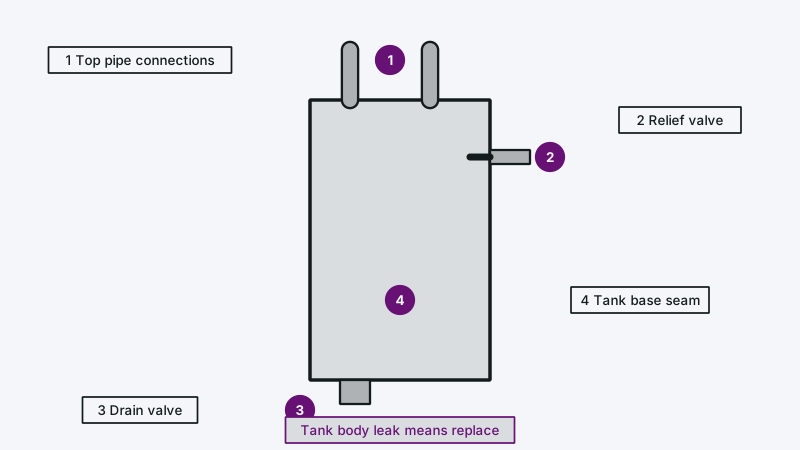
You can fix a heater leak yourself only if it begins at a fitting, valve or connector and not at the tank. Close the cold water to the heater and cut the power or gas first, dry everything off and note where the next drop shows up. If water weeps through the tank body, corrosion has eaten the steel and the heater has to go. For the wider picture, see water heater repair and replacing.
Where is my water heater leaking from?
Wipe the heater with a towel, press dry paper towel against every joint and wait fifteen minutes. Whichever paper turns wet first points to the source. Common culprits: the hot and cold pipe connections up top, the relief valve plus its discharge pipe, a drain valve near the floor, the thermostat or element gaskets on an electric tank, and the tank itself.
Damp at the base does not always mean the tank is bad. Condensation on a cold pipe, a drip from the relief valve line, or water running along the tank's exterior from a pipe above can all reach the floor. Look up before you look down.
A gas heater in a Valley garage may leave a rusty puddle when the tank fails, and with a heater in a closet the water may creep beneath the floor. Look in the drain pan if there is one, and at the ceiling below if the heater is upstairs.
Safety comes first. With an electric heater and a wet floor, flip the breaker off before touching anything and stand on something dry. On a gas unit, set the gas control to off. Should you smell gas, get out, phone 1-800-427-2200 for SoCalGas from outdoors and dial 911 if someone is hurt or in danger of it.
How do I stop a water heater leak right now?
Close the cold shutoff valve over the heater by turning the handle crosswise to the pipe, or use the house main if that one will not close. Cut the power at the breaker, or set the gas control to off. For a heavy leak, hook a garden hose to the drain valve and lead it outdoors.
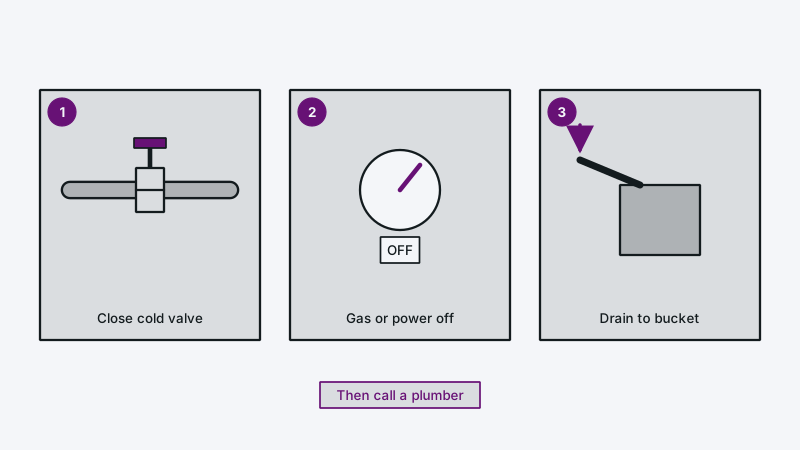
This only buys time and fixes nothing. Once the supply is closed, a pipe fitting leak stops, while a tank leak slows but continues. A tank can drip for a while as pressure falls, so set a bucket or pan beneath it.
Never power an electric heater while the tank is empty, because a dry element burns out within minutes. Keep the power off until the tank refills. For a real flood, the emergency water heater repair page lists the first moves and what to tell a plumber.
Can I fix a leak at the pipe connections or the drain valve?
Yes, if basic tools do not worry you and the leak sits at a threaded fitting, a flexible connector or the drain valve. Close the water and drain a few gallons so the level falls below the leak, snug the fitting a quarter turn, and if it still drips, replace the flex connector or redo the threads with fresh tape or sealant. A worn drain valve unscrews and a new one goes in.
Older tanks often carry brittle plastic drain valves that crack when handled. If yours is cracked or seized, a plumber is often the better choice, since forcing it can open a larger leak. Our page on water heater drain valve replacement explains the work.
Soldered copper joints need a torch, which suits someone who has done it before. Gas connections are not DIY work. California law expects a plumber who holds a contractor license to handle gas piping, and work past a simple like-for-like repair may need a permit.
What if the leak is from the relief valve or its pipe?
A relief valve that drips is usually worn, or house pressure is too high. Never plug or cap it. Wikipedia's overview of water heating describes it as a safety device with a discharge pipe leading to a drain or outside. Test it by raising the lever briefly with a bucket under the pipe. If dripping continues afterward, replace the valve.
Repeated pressure spikes cause dripping too. In a house with a check valve or backflow device on the supply, heated water expands and has no outlet. A small expansion tank plumbed into the cold supply cures that. See expansion tank replacement for that part and pressure relief valve replacement for the valve.
A valve that sends out a steady stream of hot water signals an overheating tank. Cut the power or gas and stay back. A stuck thermostat or gas control is the probable cause, and a plumber must look at it before the heater runs again.
Can a leaking water heater tank be repaired?
No. A weep from the tank body, the base seam or under the jacket tells you the metal is corroded all the way, and no sealant, epoxy or patch holds against the pressure for long. Replace the heater. A patch only postpones a bigger leak and puts the floor and walls at risk.
How soon? Close the supply right away and replace the unit within a day or two if possible. A slow weep at the bottom may last days but will not stop. If the tank is under ten years old and failed early, see whether the manufacturer's warranty covers it.
The cost of a swap varies with fuel and space, and our water heater replacement cost guide gives the ranges. Replacement normally calls for a permit and inspection, via the Burbank building division or LADBS in Los Angeles city neighborhoods, and the new heater has to be braced for earthquakes.
Request a call-out through the quote page, and someone local will inspect the heater. The price is put in writing first. Other jobs we line up are listed on the Lankershim Plumbing home page.
How do I fix a water heater that has no hot water?
Begin with the easy checks. On electric heaters, check the breaker, then the reset button beneath the thermostat cover. On gas heaters, confirm the pilot is burning and the gas control is on. If those are fine, a failed element, thermostat or thermocouple may be to blame, and a plumber should test it.
A handy person with the power off and a meter can replace heating elements and thermostats. A gas control valve or a vent problem is not DIY work. If in doubt, stop. A longer walk-through lives on our page about why you might have no hot water.
Do not keep resetting a breaker that trips again. It suggests a shorted element or a wiring fault, and repeated resets raise the fire risk.
Questions people ask
Is it safe to use hot water while my water heater leaks?
Not safely. First close the cold water to the heater and cut the power or gas. A leak from a fitting may take minutes to repair. If the tank itself leaks, leave the heater off until it is replaced, because a sudden failure can release a lot of water. Never run an electric heater empty.
Is a leaking water heater dangerous?
It can be. Water near an electric panel or a plugged-in tool is a shock hazard, and a gas heater with a wet burner area can misfire. A big leak also ruins floors and walls. Cut the power or gas, close the cold supply and keep everyone out of standing water until the circuit is dead.
What does a leaking water heater repair cost?
Repairing a fitting, valve or connector often costs about $150 to $500 including the service call, as a guide. A leaking tank means replacement, and a standard tank swap commonly runs $1,500 to $3,500 installed around Burbank. You get the real figure in writing once someone has seen the unit.
Why does my water heater drip from the relief valve pipe?
Common causes are a worn valve, high water pressure or hot water expanding in a closed system. Raise the lever briefly to flush out debris. If it still drips, replace the valve, or add an expansion tank when pressure climbs as the heater runs. Never cap the pipe. A constant blast means overheating.
Should I flush my water heater to stop leaks?
Flushing clears sediment and can stretch a tank's life, but it will not stop a leak already there. On an old tank that was never flushed, opening the drain valve can start a leak if the valve is stuck or corroded. If the tank is past ten years, ask a plumber before opening it.
References
Updated